
Debunking Trump’s Claim He Rebuilt US Nuclear Arsenal to be the Strongest in the World
Trump lets the New START Treaty--the last bilateral US nuclear arms control agreement--expire while pursuing an agreement with Moscow to extend its warhead caps for another six months.

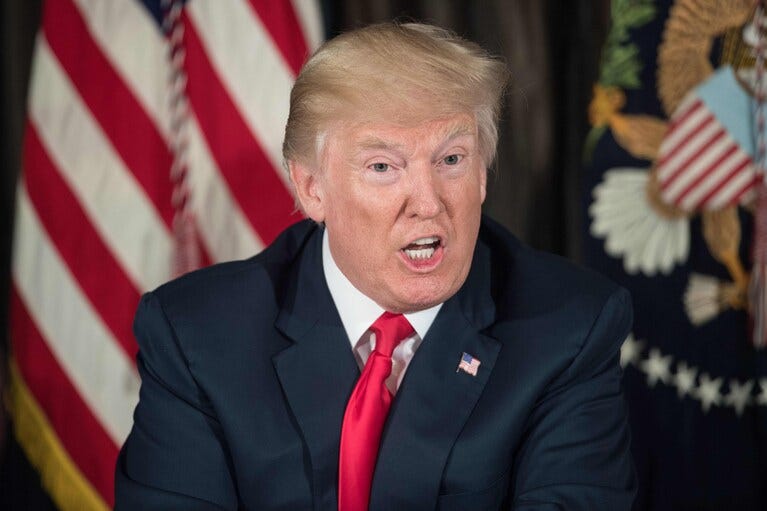
On August 9, 2017, Trump tweeted “My first order as President was to renovate and modernize our nuclear arsenal. It is now far stronger and more powerful than ever before.” The Washington Post rightly gave his claim a four Pinocchio rating.
In December 2016, one month before he first became President, Donald Trump made a series of statements that contained his first and clearest support up until that point to massively expand the U.S. nuclear arsenal. “The United States must greatly strengthen and expand its nuclear capability until such time as the world comes to its senses regarding nukes,” he said in a tweet. A day later, Trump said in a TV interview: “Let it be an arms race. We will outmatch them at every pass
Defense One reported that the month after he was first inaugurated, Trump rightly rejected Russian President Vladimir Putin’s offer to extend the New START Treaty which until its expiration last week limited both the US and Russia to 1,550 treaty accountable strategic nuclear warheads each.
Just a couple weeks after first becoming President, Trump railed at Putin in their recent phone call, denouncing the 2010 New START nuclear arms limitation pact as a “bad deal.” It should have been a routine courtesy call. But according to Reuters, “When Putin raised the possibility of extending the 2010 treaty... Trump paused to ask his aides in an aside what the treaty was.” He then reprised campaign rhetoric about how one-sided the treaty is, claiming that it gave Russia a strategic nuclear advantage later telling aides he wanted to massive expand the US nuclear arsenal instead.
After he received a briefing on July 20th, 2017, as to how the US had unilaterally disarmed its nuclear arsenal by ninety percent from 22,000 operational nuclear weapons to over 2,200 since the end of the Cold War. At that time, he exclaimed that he wanted to increase the size of the US nuclear arsenal “by ten times” causing then Secretary of State Rex Tillerson to call him “a moron.” Just three weeks after this briefing in which he expressed profound shock that the Cold War winning US nuclear arsenal had been reduced by ninety percent, Trump began claiming in August 2017 that he had rebuilt the US nuclear arsenal in just his first seven months as President.
On August 9 2017, Trump declared,: His first order as president was to “renovate and modernize” the U.S. nuclear arsenal, and now it is “far stronger and more powerful than ever before.” To be clear, efforts to modernize America’s nuclear arsenal were long underway before Trump took office and are years from completion. Its nuclear arsenal has actually shrunk over the last seven months to meet the conditions of New START, the strategic arms reduction treaty, noted defense budget analyst Todd Harrison of the Center for Strategic and International Studies.
With regards to Trump’s claim that he had massive increased the size of the US nuclear arsenal during his first seven months in office, “This is patently absurd,” Stephen Schwartz, former editor of the Nonproliferation Review, said in a tweet responding to Trump. “Literally nothing has happened in the last 201 days to increase the overall power of the US nuclear arsenal.” The senior policy director at the Center for Arms Control and Non-Proliferation, Alexandra Bell, called Trump’s claims “a total lie” in her own tweet. “Modernization plans for nuclear arsenal were well underway before [Trump] came into office & his own budget isn’t passed yet,” she said in another.
On October 11, 2017, he walked back his July statement that he wanted to expand the US nuclear arsenal by ten times saying we did not need an increase in the size of America’s nuclear arsenal suggesting it was strong enough as it is. At that time Trump stated, “I want to have absolutely, perfectly maintained — which we are in the process of doing — nuclear force,” he said. “But when they said I want 10 times what we have right now, it’s totally unnecessary, believe me, because I know what we have right now. We won’t need an increase but I want modernization and I want total rehabilitation. It’s got to be in tip-top shape.”
Trump Claims the US has the Biggest Nuclear Arsenal in the World
During his September 30th, 2025 speech to hundreds of US military flag officers forced to gather for what sounded like a campaign rally at Marine Corps Base Quantico in Virginia, President Trump falsely claimed the US had the biggest, newest and best nuclear arsenal in the world. Referring to the US nuclear arsenal during his speech to top US military commanders at Quantico on September 30th, Trump claimed “Frankly if it does get to use, we have more than anyone else. We have better. We have newer.” all of which are false. During this speech he repeated this misleading claim he first made eight years before when he stated his first order as President was to “renovate and modernize” the U.S. nuclear arsenal, and now it is “far stronger and more powerful than ever before.” He then added that he ordered a couple of US nuclear missile submarines in firing position against Russia in response to former Russian President Dmitri Medvedev’s warning that Russia possesses its Perimeter or “Dead Hand” system which is designed to fire all of Russia’s deployed strategic nuclear warheads (which total up to 6,000 according to a recently disclosed top-secret Ukrainian Ministry of Defense report) at the US in the event communications between Russia’s nuclear triad and Russia’s nuclear command authority was lost.
As reported by Microsoft News:
He said: ‘Frankly if it does get to it, we have more [nuclear weapons] than anyone else. We have better, we have newer [weapons]’, the US president bragged. ‘But it’s something we don’t ever want to even have to think about.’ Trump also admitted that ‘we were a little bit threatened by Russia recently’ and said the US sent a nuclear submarine after Russian Deputy Chairman of the Security Council Dmitry Medvedev made a veiled threat against his administration back in August. ‘Based on [Medvedev’s] mention of nuclear... I moved a submarine or two over to the coast of Russia - just to be careful, because we can’t let people throw around that word’, Trump said.
The President’s remarks come after Putin’s ally told Trump last month to remember that Moscow possessed Soviet-era nuclear strike capabilities of last resort. Trump, in a Truth Social post, had singled out Medvedev for sharp criticism after he said that Trump’s threat of hitting Russia and buyers of its oil with punitive tariffs was ‘a game of ultimatums’ and a step closer towards a war between Russia and the US.’ Tell Medvedev, the failed former President of Russia, who thinks he’s still President, to watch his words. He’s entering very dangerous territory!,’ Trump wrote at the time.
Medvedev responded by saying Trump should remember, he said, ‘how dangerous the fabled ‘Dead Hand’ can be,’ a reference to a secretive semi-automated Russian command system designed to launch Moscow’s nuclear missiles if its leadership had been taken out in a decapitating strike by a foe. Trump also rebuked Medvedev in July, accusing him of throwing around the ‘N (nuclear) word’ after the Russian official criticized US strikes on Iran and said ‘a number of countries’ were ready to supply Iran with nuclear warheads.
Lest there was any doubt about it, Conservative Review quoted the commander of Russia’s Strategic Rocket Forces in charge of Russia’s vast nuclear arsenal as saying Russia’s Perimeter/‘Dead Hand’ system is currently operational.
Putin’s right-hand man added, “Let him remember his favorite movies about ‘The Walking Dead,’ as well as how dangerous the non-existent in nature ‘Dead Hand’ can be.” “Dead Hand” is a reference to a nuclear weapon launch system that could apparently trigger nuclear attacks across the U.S. in the event that a nuclear strike on Moscow is detected or if communications with top Russian leaders drop off. Russian Strategic Rocket Forces Col. Gen. Sergey Karakayev told the Russian newspaper Komsomolskaya Pravda in a 2011 interview that the system was indeed “on combat duty.”
An article published a few months ago by Eric Edelman, a former Undersecretary of Defense for Policy, and Franklin Miller who served as Senior Director for Defense Policy and Arms Control on the National Security Council rebutted Trump’s statements that the US nuclear arsenal is stronger than Russia’s while noting that our nuclear triad has not undergone modernization of any kind for decades.
Despite his well know aversion to using the other “N” word and discussing the issues connected with nuclear deterrence and nuclear sabre rattling by America’s adversaries the President, during his trip to Asia this week, dropped a bit of a bombshell of his own. On October 29, President Trump posted a brief statement on Truth Social about nuclear weapons testing, which contained the following key points:
“The United States has more nuclear weapons than any other country”
“In my first term in office” the U.S. “accomplished a complete update and renovation of existing [U.S. nuclear] weapons.
“because of other countries testing programs I have instructed the Department of War to start testing our nuclear weapons on an equal basis”
The process of testing our nuclear weapons “will begin immediately.”
Sadly, whoever provided the President with the background information for each of his statements is manifestly unaware of the easily ascertainable facts, and so the President is being extremely poorly served by his own staff. First, the Russian Federation has more nuclear weapons than any other nation. Second, during the President’s first term progress was made on the “Strategic Modernization Program” initiated in 2010, but no ew platforms (submarine-launched ballistic missiles, bombers or land-based missiles) were deployed between 2017 and 2021; we rely today instead on aging systems which are decades old. Very importantly a small number of modified low yield submarine launched warheads were produced and placed in service, and development work began on other new air force nuclear warheads, but none were deployed.
Based on over 30 years of neglect, that Department would be unable today to conduct a nuclear weapon test in the near future. Rather, based on estimates provided to the Congress by DOE, it would take 24-36 months to do so, at a cost of several billion dollars – dollars which have not been authorized or appropriated by Congress. Parenthetically, the President appears to have been advised that extending the New START treaty (which expires next February) a proposal raised by Russian President Vladimir Putin, might be a good idea; it is not, the treaty today is very much in Russia’s interest and very harmful to our own.
On February 5th, Trump again repeated his misleading claim that he built many “new and many refurbished nuclear weapons” during his first term. In fact, there is nothing Trump did during the first eight months of his Presidency to make the US nuclear arsenal “far stronger and more powerful than ever before.” The US nuclear arsenal boasted 32,000 warheads during its peak during the late 1960s and is far weaker and less powerful today. President Trump’s actual record during his first term in office was one of unilateral nuclear disarmament. During his first term, he scrapped eleven Minuteman III ICBMs and eleven strategic nuclear warheads (of 300-475 kiloton yields each) as part of the final implementation of former President Barack Obama’s “terrible” New START Treaty.
In terms of both total numbers of nuclear warheads and especially overall nuclear firepower, the US nuclear arsenal hasn’t been as weak as it is today since the early 1960’s if not the late 1950’s. Moreover, he replaced 8-32 Trident II SLBM strategic nuclear warheads with 8-32 low-yield non-strategic five-kiloton SLBM warheads. These changes likely actually served to decrease the total megatonnage of America’s operational US nuclear arsenal by as much as 20.3 megatons which equates to nearly three percent of the US nuclear firepower Trump inherited from the Obama administration when he became President in January 2017. That may not seem like a lot but is still a strategically significant percentage in an area in which the US nuclear arsenal faces marked and increasing nuclear inferiority vis a vis the combined strategic nuclear arsenals of the Russian Federation and the People’s Republic of China.
Sino-Russian Nuclear Supremacy Over the US
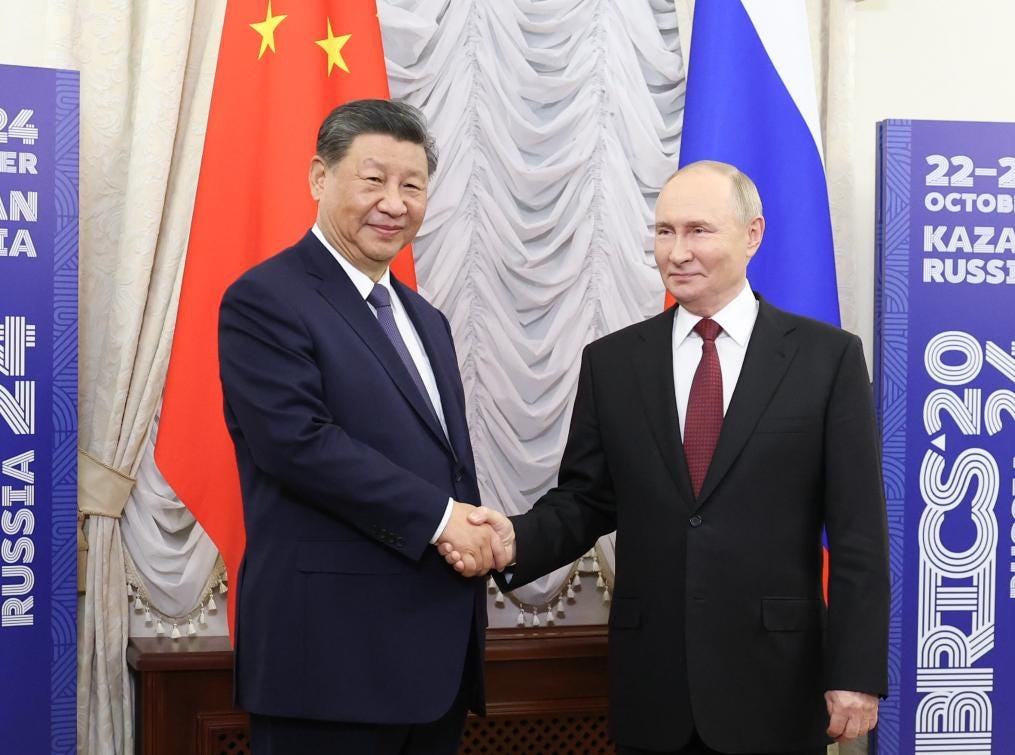
Chinese President Xi Jinping and Russian President Vladimir Putin meeting in October 2024 at a summit meeting of the Shanghai Coopertion Organization—the Russian and Chinese military alliance which has grown to include a host of nations including India, Pakistan and Iran. Russia and China together have many times more nukes than the US.
During a press conference on October 22nd, Trump again repeated his false claim, “We have the most nukes, Russia is second, China is third by a long way, but they will be even within 4-5 years.” Unfortunately, Trump is mistaken in his claims that the US has the most nuclear weapons. Russia has the most nuclear weapons and its not even close--16,000 total according to the aforementioned leaked Ukrainian MoD report with China likely in second place with up to 4,000 nuclear warheads and the US in third place with approximately 2,285 operational nuclear warheads and another 1,500 partially dismantled warheads that would take 6-24 months to re-assemble and re-deploy. Furthermore, the US strategic nuclear triad has become increasingly obsolescent lasting decades past its planned life cycle with no new strategic warheads or ICBMs being built in the past thirty-three years while Russia’s strategic nuclear arsenal is 95 percent modernized and China’s and North Korea’s nuclear arsenal is far more modern than our own.
The nuclear imbalance of terror was not always so heavily weighted in favor of America’s adversaries. The U.S. enjoyed nuclear superiority over the Soviet Union from 1945 until the SALT I Treaty was signed in 1972 enabling the U.S. to fight wars in Korea and Vietnam with only a very minimal fear of Russian nuclear escalation. Few Americans realize that the US boasted five to nine times more nuclear warheads than the Soviets during the Cuban Missile Crisis of 1962, a fact that undoubtedly played a major role in persuading them to seek a diplomatic solution and de-escalation of the crisis. While the US continued to enjoy rough nuclear parity with Russia for the first decade after the end of the First Cold War, it then began unilaterally disarming its nuclear arsenal at a much faster rate leaving the Russians with nearly four and a half times as many operational nuclear weapons as we have making the Russian Federation the uncontested winner of the nuclear arms race. Russia has spent the equivalent of over a trillion dollars to heavily modernize and subsequently expand its strategic and non-strategic nuclear arsenal and its national missile defense system over the past few decades with 95 percent of Russia’s nuclear arsenal having been modernized as opposed to zero percent of America’s nuclear arsenal.
Regrettably, the nuclear balance of power between the US and its nuclear superpower enemies—the Russian Federation and the People’s Republic of China-- has changed drastically over the past two decades. While the U.S. once boasted over 20,000 non-strategic nuclear warheads at the height of the Cold War with the Soviet Union with 7,200 deployed to deter a Russian invasion of NATO and 1,500 deployed on Taiwan, today it has a little over one percent of that number deployed in Europe to deter hypothetical Russian aggression. The US has virtually no non-strategic nuclear warheads deployed in East Asia and the Western Pacific to deter Chinese aggression effectively giving China absolute theater nuclear supremacy over the U.S. in any future Pacific War waged over Taiwan or our Pacific Treaty allies. A recently disclosed Ukrainian Ministry of Defense report estimated Russia as having 16,000 nuclear weapons including 6,000 strategic nuclear warheads while the US has no more than 2,285 operational nuclear weapons including reserve warheads. Assuming they are all operational, that would mean Russia has nearly three times more operational strategic nuclear warheads than we do and over seven times more than we do overall, which amounts to Russian nuclear supremacy over the US. Adding China’s up to 4,000 nuclear warheads, to the combined Russian total serves to underscore America’s nuclear inferiority.
One reason why Trump may be backing away from military confrontation with China in his recently released National Security Strategy and National Defense Strategy documents is their massive nuclear buildup and May 2025 DIA estimate that China will have nearly 5,000 intercontinental nuclear missiles by 2035 including 4,000 Hypersonic Glide Vehicles (HGVs), 700 Intercontinental Ballistic Missiles (ICBMs), at least 132 Sea-Launched Ballistic Missiles (SLBMs) in addition to 5,000 shorter range nuclear capable Land Attack Cruise Missiles (LACMs). DIA also estimates China will have at least 60 nuclear missiles which could be deployed as part of a Fractional Orbital Bombardment System that could be used as orbital strike weapons that could hit the US with only ten minutes warning as part of a nuclear decapitation strike/nuclear first strike against Washington, DC. It was this Soviet capability back in 1967 that spooked the US into signing the Outer Space Treaty banning nuclear weapons in space. The Soviets were only believed to have deployed eighteen FOBS missiles during the Cold War and now US intelligence has reported that China will soon have over three times as many within the next nine years. By way of comparison, the US currently has no HGVs, 400 ICBMs and 240 SLBMs and no FOBS meaning that China could soon achieve nuclear supremacy over the US much as Russia has arguably already done.
Trump claims US is far ahead of Russia in Nuclear Missile Submarine Technology
Trump has also claimed during the past four to five months that the US is twenty-five years ahead of the Russians in nuclear missile submarine technology which is also false. In fact, the US Navy has admitted it cannot track Russia’s newest ultra-quiet and stealthy Yasen-class nuclear missile submarines having lost track of the Yasen-class submarine Severodvinsk for weeks due to the fact its hull is made of non or low-magnetic steel, which either significantly reduces or eliminates the Severodvinsk’s magnetic signature.
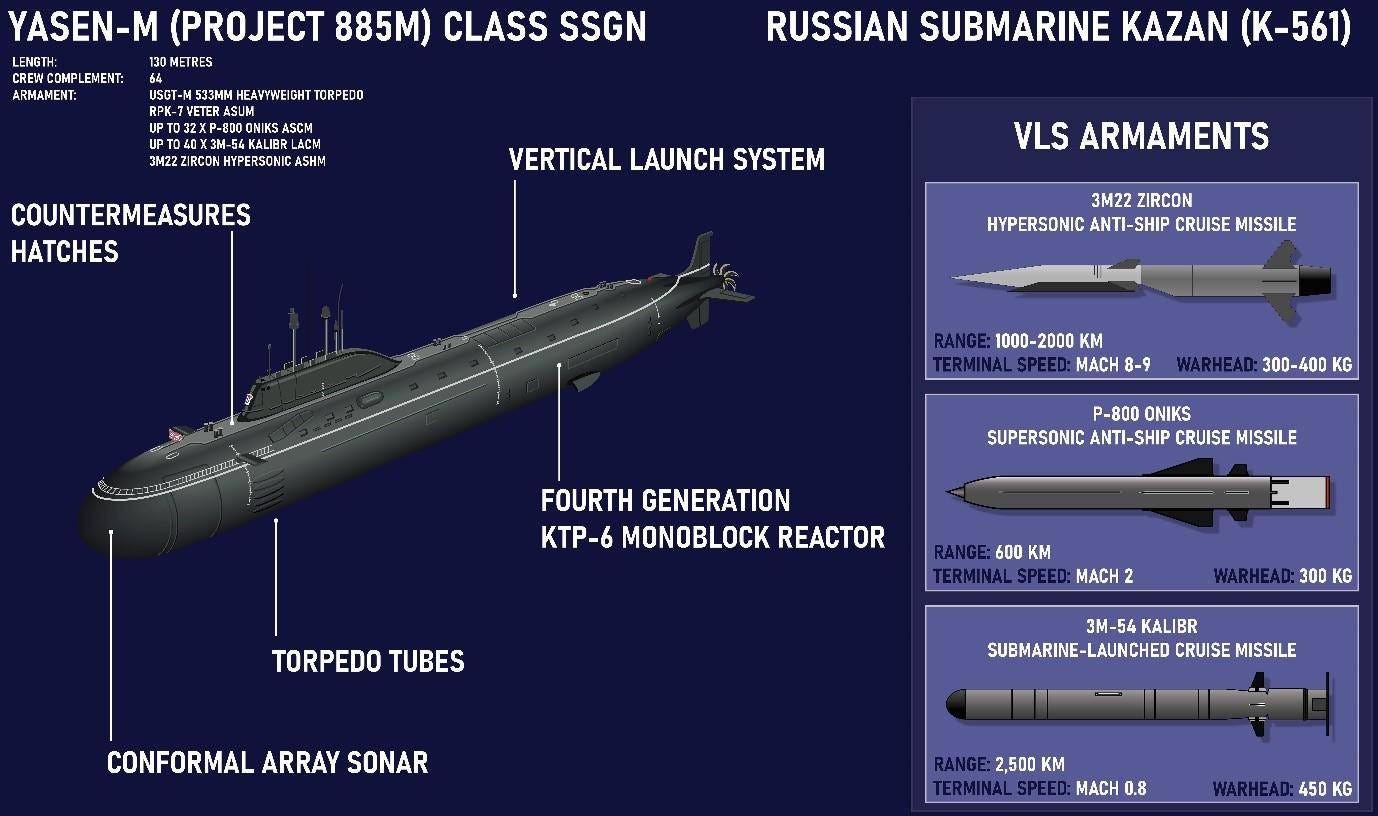
An artist’s depiction of a Russian Yasen-M submarine and its nuclear-capable missiles including the Zircon nuclear hypersonic cruse missile which could destroy Washington, DC within five minutes if fired within 200 miles of the capital in a nuclear decapitation strike that could potentially take out all three nuclear footballs and cause the US to lose launch control of its nuclear triad for days.
Defense Feeds reported on the Yasen-M nuclear cruise missile submarines advanced stealth capabilities which far exceeds that of any nuclear missile submarine currently in the US Navy’s inventory.
With these capabilities, the Yasen-M-class submarine can traverse vast distances and position itself within striking range of its targets, all while remaining nearly invisible to enemy detection systems. This makes it an invaluable asset to Russia’s naval forces, providing them with a nearly invulnerable platform for launching precision strikes from beneath the waves. A strategic advantage of the Yasen-M-class submarines is the ability to deploy the Tsirkon hypersonic cruise missile. This weapon is not only fast but also highly unpredictable, giving it a substantial edge over traditional cruise missiles.
Traveling at speeds of up to Mach 9, or around 7,000 miles per hour, the Tsirkon can cover a range of approximately 620 miles. What makes this missile particularly dangerous is its ability to perform radical maneuvers during flight, making it almost impossible for modern missile defense systems to intercept. This rapidly advancing technological gap highlights the need for the West to adapt. In the short term, this may mean investing in new counter-hypersonic technologies and revising strategies to deal with the increasing stealth capabilities of Russia’s naval forces. However, these solutions are still in development, meaning Russia will maintain a strategic advantage for the foreseeable future.
In February 2022, during the run-up to Biden’s war in Ukraine, Putin threatened to nuke Washington, DC with five minutes warning using a Zircon hypersonic missile fired from a Yasen submarine which the US Navy remains unable to detect at a 200-mile distance before he could escape on Air Force One or a Nuclear Command, Control and Communications (NC3) TACAMO Aircraft. If the President and Vice President were both killed in such an attack, such an attack could potentially destroy all three presidential emergency satchels, which are popularly referred to as the ‘nuclear footballs’ causing the US to lose launch control of the US nuclear arsenal for days according to COL Rob Maness (USAF Ret.) (who wrote the handbook for the nuclear football) if not longer. During that time, Russia, China, North Korea to nuke every target in the US with impunity at their leisure with no fear of a US nuclear retaliatory response or else blackmail us into surrender.
A few years ago, former Assistant Secretary of Defense Frank Gaffney revealed that a Russian submarine had to be chased out of the Chesapeake Bay near Washington, DC. The Chesapeake is no more than forty-four feet deep so it is shocking that a Russian submarine would be able to evade US detection systems to breach it. This incident showcased how easy it would be for Russia to launch a nuclear decapitation strike on the US nuclear command authorities in our nation’s capital that could kill not just the President and Vice President but most of the Cabinet and congressional leadership as well. An orbital nuclear strike from a Russian or Chinese Fractional Orbital Bombardment System or hypersonic glide vehicle in orbit would give us as little as ten minutes warning. The US has no missile defense systems in place to defend Washington, DC against any nuclear missile strike. A proposal to build a new missile defense site in the Northeast and deploy several dozen Ground Based Interceptors to defend the Capital was shot down by the Biden administration a few years ago.
The US Nuclear Warhead and Strategic Delivery System Procurement Holiday
The SALT I Treaty, which was signed in 1972, gave the Soviets rough nuclear parity for the first time ever after which the Russians began to overtake the U.S. both in terms of numbers of strategic nuclear warheads and delivery systems as well as the aggregate explosive power of their nuclear arsenal which was twice as great as ours by the late 1980’s. However, following the collapse of the Soviet Union in 1991, the U.S. effectively dropped out of the nuclear arms race, failing to test or build a single strategic nuclear warhead for nearly thirty-seven years, failing to deploy a single new strategic nuclear delivery system since the Trident II SLBM which was first deployed in 1990.
On October 30th, the commander of US Strategic Command, Admiral Richard Correll, testified before the Senate Armed Services Committee that US nuclear modernization on the current scale has not taken place in nearly forty years rebutting Trump’s claim that he rebuilt and modernized the US nuclear arsenal during his first year in office. He also stated with regards to the US facing two allied peer nuclear superpower adversaries, “Today, the United States faces one of the most unprecedented strategic environments in our nation’s history,” he said. “However, nuclear modernization on the current scale has not taken place in nearly 40 years. “Consequently, our supporting infrastructure, production capabilities, and defense industrial base have significantly atrophied,” he said.
The United States has not tested or built a single nuclear warhead from scratch since 1992, nor have we built a single strategic delivery system since that time. The US Sentinel missile program and Columbia-class ballistic missile submarines are years behind schedule and will likely not begin being deployed until 2030 or beyond. During the past more than thirty-three years, Russia, China and North Korea have deployed 20-25 strategic nuclear delivery system and have built many thousands if not tens of thousands of advanced new nuclear warheads while the US has not deployed a single new strategic nuclear delivery system since it began deploying the Trident II SLBM in 1992. The US has produced no new plutonium pits, which are used to build new nuclear warheads since 1989. Russia, China and North Korea have produced several thousand if not tens of thousands of new nuclear warheads since that time. While the US has struggled to build even a few new nuclear warheads to reach its goal to produce 80 warheads a year, Russia reportedly can produce 3,000 a year and the PRC has been building hundreds a year.
A few months ago, former Deputy Under Secretary of Defense Stephen Bryen reported on how far the US is behind our nuclear-armed adversaries when it comes to nuclear warhead production and testing which nuclear experts are taking would take a few years at least.
“The US is developing a number of new nuclear warheads and is modernizing older ones. It is also concerned about the reliability and safety of existing nuclear warheads. Among the issues are ageing electronics, conventional explosives inside nuclear warheads that are vulnerable in case of an accident, and needed upgrades including boost gas in primaries, to ensure warhead reliability. This is done by adding more thermonuclear fuel mixture (typically deuterium and tritium gas) to the primary (fission) stage of a boosted fission or thermonuclear (hydrogen) weapon. New warheads in development include the W87-1 for Sentinel missiles. The Sentinel is a multibillion dollar ICBM program to replace the Minuteman III. The US Navy is carrying out a life extension program for its W88 nuclear warheads, designed in the 1970s and used on US Trident D-5 submarine launched ballistic missiles. The last W88s were produced in 1992. The Navy also is planning a new warhead for the D-5 missiles, the W93. Other programs for the B-61 gravity bomb (”dial a blast”) and a new cruise missile to replace the Tomahawk also are underway or in planning.
The US would also have to restart the manufacturing of plutonium pits for the warheads prior to any real testing process. A plutonium pit is the central, fissile core of a modern nuclear weapon’s primary stage. It is the component that, when compressed, undergoes a fission chain reaction to generate the initial massive energy release. None have been produced for more than the past three decades (last produced in 1989), but the Department of Energy has announced that the National Nuclear Safety Administration will renew nuclear pits production. The DOE says that “given the uncertainties regarding plutonium aging and the evolving geopolitical landscape, the United States cannot postpone reestablishing this critical capability.” Nuclear pits deteriorate slowly. Recent estimates suggest that the service life of a nuclear pit could be 100 years, suggesting that there is no urgent need to replace them in older weapons. But to produce new weapons, like the warhead for the Sentinel ICBM, nuclear pit production will be required. The DOE plan is to manufacture 30 units per year at the Los Alamos National Laboratory, followed by a new production plant at the Savannah River Site, at 50 units per year.”
Tony Bruno, President and CEO of United Launch Alliance, published a good article in the Washington Times summarizing the supreme folly of unbelievably foolish and naive US leaders from George HW Bush to Barack Obama in unilaterally disarming the US nuclear arsenal by ninety percent following the end of the Cold War. Russia retained a much larger, more advanced and far more powerful nuclear deterrent and China engaged in a massive nuclear buildup to give them a first strike capability against the US. He stated:
“Our [nuclear] forces, the foundation that enabled engagement, were allowed to dwindle and atrophy. Compounding this state, a misguided strategy of “leading by example” was adopted. For example, concerned about Russia’s tactical nukes, we unilaterally limited the number of our nuclear-armed cruise missiles. When this had no effect on the size of Russia’s vast tactical nuclear arsenal, we withdrew ours from active deployment. When Russia reciprocated by forward deploying theirs to the edge of European borders, we tried decommissioning ours. We have been slow learners. Our naive strategy was flawed and has made the world more dangerous, not safer. Russia is modernizing every nuclear system it has, introducing novel ones and expanding its warfighting tactical nukes. We must modernize our systems, showing commitment to new and more capable systems. We must match and balance any Russian or Chinese capability while assembling a Golden Dome, making it obvious that these countries cannot count on a free hand.”
Trump’s Announcement of the New Trump-Class ‘Battleships’
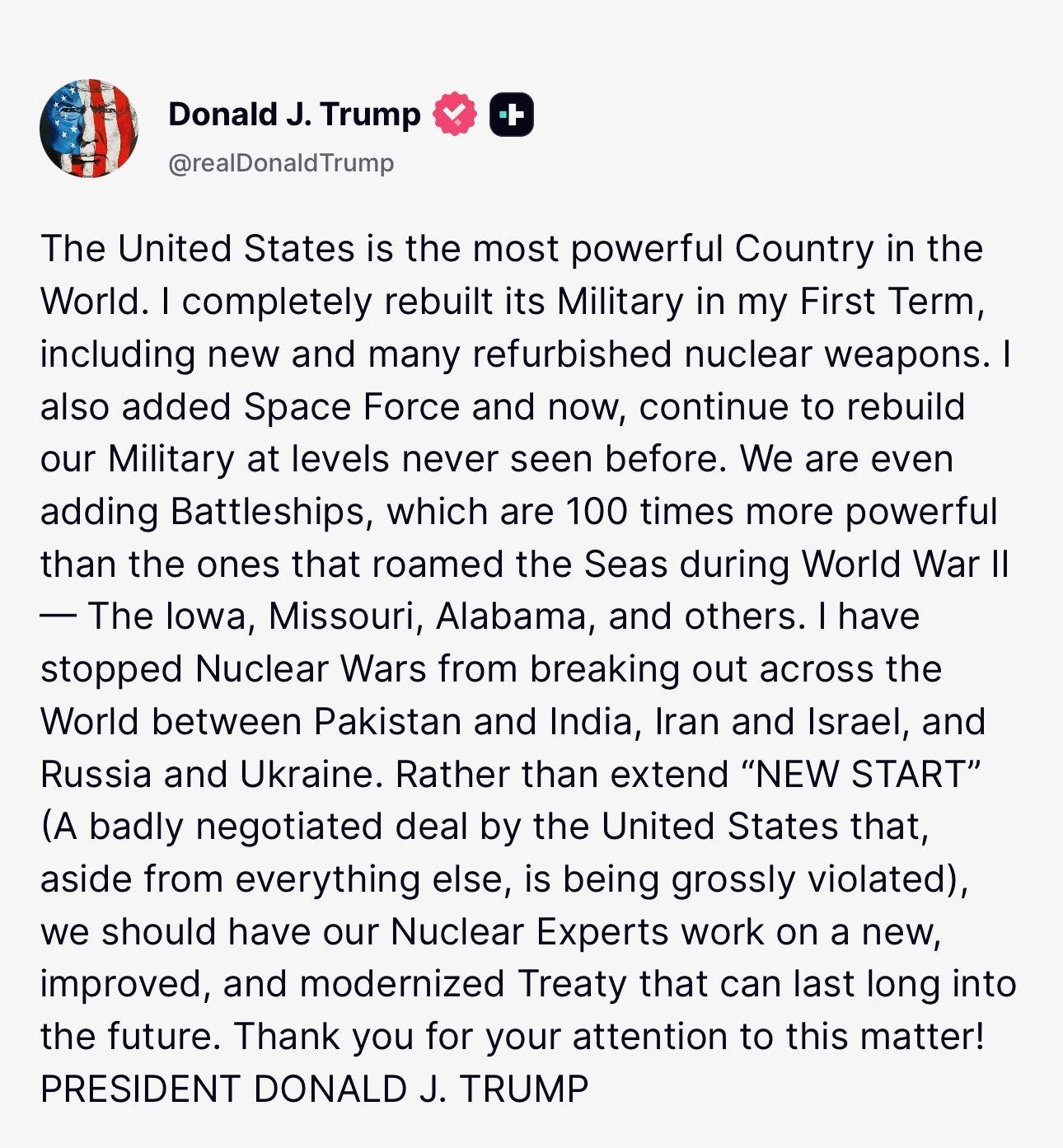
Trump’s penchant for exaggerating US military capabilities is not limited to the nuclear arena. In his Truth Social post earlier this month, he also boasted “The US is the most powerful country in the world” while his Press Secretary Karoline Leavitt boasted during the White House Press Conference held the same day that “The US has the most powerful military in the history of the world” ignoring the fact that Russia has the most nuclear weapons by far while China has the largest army, navy, air force, coast guard and the largest nuclear-capable ballistic missile force in the world. Her claim also demonstrated her ignorance of US history given that the US itself boasted fifteen million men under arms and a navy consisting of 8,000 ships during World War Two whereas today the US is perhaps the fifth largest military with only 1.3 million active-duty military servicemembers behind China, Russia, India and North Korea with a navy consisting of approximately 287 battle force ships compared to 395 for China’s PLA Navy. During the Cold War, the US boasted 44 nuclear ballistic missile submarines while today we only have 14. As recently as 1991 we had ten times more operational nuclear warheads as we have today. Whereas the US once deployed 7,200 non-strategic nuclear warheads in Europe and 1,500 in Taiwan, we now have only 100-150 in Europe and none in East Asia or the Western Pacific.
During a press conference on December 22nd, Secretary of the Navy John Phelan made similarly exaggerated claims while announcing the new planned 30,000-40,000 ton Trump-class ‘battleships’ claiming they would be the largest and most powerful warships ever built ignoring the fact that the US Navy currently deploys eleven aircraft carriers which are nearly three times larger by tonnage. It is clear to naval experts and naval enthusiasts like myself that the new ships would not meet the requirements to be actual battleships and at best would just be considered battlecruisers similar to Russia’s 25,000-ton Kirov-class battlecruisers.
He also claimed that once production started, the US would have the biggest naval production shipbuilding program in the world, apparently ignorant of the fact that a leaked top-secret US intelligence report assessed that China could build ships 232 times faster than we can. President Trump claimed these new “battleships” would be 100 times more powerful than the ones the US used to help win the Second World War. While announcing the new battleships, he said they would be equipped with nuclear-tipped cruise missiles, the first time, US surface vessels have been equipped with nuclear weapons since at least 2003. That would certainly constitute a very positive and much overdue development given that all major Russian major surface combatants and submarines are likely equipped with nuclear missiles and most Chinese submarines and major surface combatants likely are as well.
The US Navy’s press office reported on President Trump’s and Navy Secretary Phelan’s comments at the press conference:
“As commander in chief, it’s my great honor to announce that I have approved a plan for the Navy to begin the construction of two brand-new, very large — largest we’ve ever built — battleships,” Trump announced from his Mar-a-Lago residence in Palm Beach, Florida. The president noted that the Navy aims to have a fleet of 20 to 25 ships eventually. “The future Trump-class battleship, the USS Defiant, will be the largest, deadliest and most versatile and best-looking warship anywhere on the world’s oceans,” Phelan said, adding that he wanted to thank the president for his vision to make the future battleship a game-changing capability for the U.S. Navy. Phelan also compared the future Trump-class battleships to the former Iowa-class battleships, which were a cornerstone of the Navy’s warship fleet for much of the 20th century. “The Iowa was designed to go on the attack with the biggest guns, and that’s exactly what will define the Trump-class battleships: offensive firepower from the biggest guns of our era,” Phelan said.
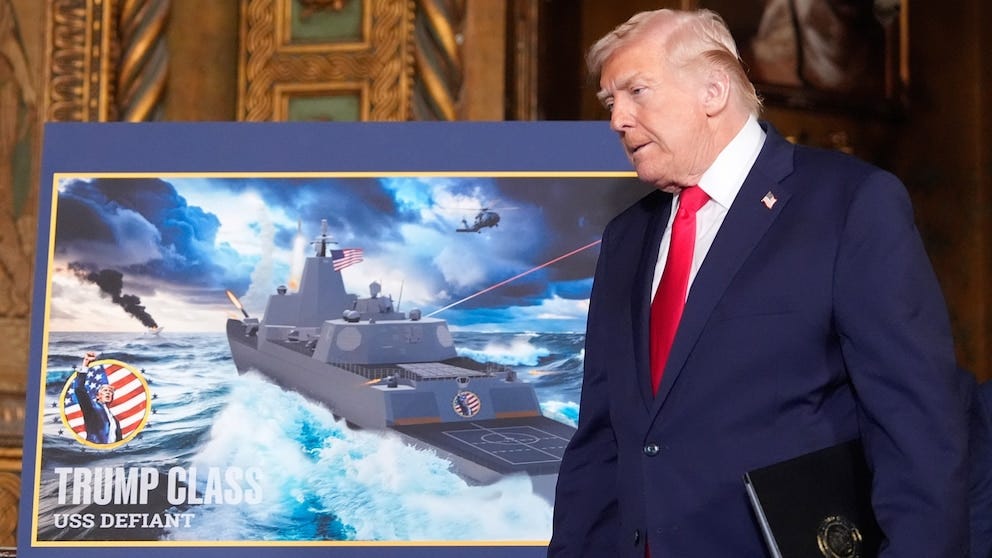
President Trump following his announcement of a new US Navy ‘battleship’ class named after himself. Critics warn it would be prohibitively expensive which would add little capability to the US navy’s arsenal.
Phelan’s claim that the Trump-class battleships would have the largest guns is patently ridiculous given that the designs released indicated that the largest guns they would be equipped with two five inch guns which are far smaller and less powerful than the nine 16-inch guns deployed on our World War Two-era Iowa-class battleships from 1942-1992. An article published last month on the website ‘19fortyfive’ estimates the cost of the lead ship at $18-22 billion without much additional conventional firepower capabilities over and above our existing Ticonderoga-class cruisers and Arleigh Burke-class destroyers.
A preliminary range cited by analysts and reporters places the lead ship at roughly $18–22 billion, exceeding even the price of the Ford-class carriers, while follow-on hulls are projected to fall to the low teens per ship (in the best-case scenario). Early Navy materials reviewed by reporters described a ship roughly double the tonnage of the Zumwalt-class, carrying 128 Mk-41 VLS cells and 12 CPS tubes, and capable of more than 30 knots, positioning it as a flagship for Surface Action Groups with expanded aviation and command facilities.
At that cost, they would represent an economic boondoggle and likely would never be built as the hundreds of billions of dollars needed to build them could be much better utilized by procuring more cost-effective capabilities. Furthermore, there have been reports that insufficient US naval port and maintenance facilities have resulted in the OPTEMPO of US Navy attack submarines decreasing significantly with nearly thirty-seven percent of US attack submarines out of commission as of August 2023. In fact, on Los Angeles class attack submarine, the USS Boise, has been waiting in port to be refitted and repaired since 2015 and is not expected to return to active service until 2029. Prioritizing the building of these new battlecruisers over maintaining our existing attack submarine fleet and restoring them to operational status could prove disastrous in a hypothetical future war with the PRC over Taiwan. Notably, the Trump-class ‘battleships’ are planned to only have 128 Vertical Launch Tubes which is just six more than the US Navy’s Ticonderoga-class cruisers which weigh over three and a half times less and cost only $2.1 billion in adjusted 2025 dollars. This leads one to ask what added value the US Navy would get from building a warship that is ten times more expensive with only five percent more missile launchers. Ultimately, the ship seems to be a waste of money and little more than a vanity project for President Trump, who like me appears to be a lifelong battleship enthusiast.
Trump Flip Flops on Extending the New START Treaty
In February 2017, Trump derided Obama’s New START in an interview with Reuters as “a one-sided deal,” saying that “if countries are going to have nukes, we’re going to be at the top of the pack.” In July, Trump came out in strong support for extending Obama’s New START Treaty which spent his entire first term criticizing and refusing to extend. Russia has committed multiple egregious violations of the New START Treaty with multiple nuclear delivery systems which cross the strategic threshold. As Dr. Mark Schneider, America’s foremost expert on Russia’s nuclear arsenal has noted, “Russia’s New START violations are important because compliance with the New START Treaty impacts the U.S. nuclear deterrent a great deal. According to then-STRATCOM Commander Admiral Charles Richard “…two-thirds of those [U.S. nuclear] weapons are ‘operationally unavailable’ because of treaty constraints, such as provisions of the New START treaty with Russia.”
As I noted in my previous article, during his first term, President Trump wisely refused to sign up for an extension to the New START Treaty unless China also agreed to abide by the strategic nuclear arms limitations of 1,550 treaty accountable warheads per side. Russia suspended its adherence to the New START Treaty and withdrew its ratification of the Comprehensive Nuclear Test Ban Treaties in 2023 in response to Biden’s war against Russia in Ukraine. In February 2025, Trump said he wanted to negotiate a nuclear arms control agreement with Russia and China and in July, President Trump stated he wanted to extend the New START Treaty.
In September, Putin offered a one-year extension of the New START Treaty to allow time for the US and the Russian Federation to negotiate a new arms control treaty. Of course, both Russia and China want us to extend our adherence to the New START Treaty because it essentially serves to lock the US to a position of nuclear inferiority making it more difficult to deter them than ever and essentially ensures a Sino-Russian victory over us in the event a nuclear war breaks out between the three superpowers.
Putin offered to extend the New START Treaty limits by one year and declared that he thought the British and French nuclear arsenals should be included in any nuclear warhead caps. On September 22nd, White House Press Secretary Karoline Leavitt responded at her regular press conference: “The President is aware of this offer extended by President Putin, and I’ll let him comment on it later. I think it sounds pretty good, but he wants to make some comments on that himself, and I will let him do that.” When asked about the proposal, Trump said Sunday it “sounds like a good idea to me.”
The UK currently has 225 nuclear weapons, and France is believed to have 290 for a total of 515 nuclear weapons. If the US were to include Britain and France in its 1,550 New START maximum warhead total it could reduce the size of the US nuclear arsenal down to just over 1,000 strategic nuclear warheads which has been a longtime Russian objective to reduce the US strategic nuclear arsenal below the levels needed for minimum deterrence. President Trump should counter that any extension must include China’s massively expanding nuclear arsenal or the US will refuse to extend it. Even better as I have long been advocating, Trump could agree to START II Treaty limits of 3,500 warheads each for the US and Russia and then begin expanding the size of our nuclear arsenal to that level.
However, the administration has never formally responded to the Kremlin’s proposal to extend the sole-surviving bilateral nuclear arms control agreement. Last month, President Trump changed his tune yet again. When asked about New START Treaty’s impeding expiration on February 5th, he stated, “If it expires, it expires,” President Trump said about the treaty during a New York Times interview given Wednesday. “We’ll just do a better agreement.”
Critics are worried the expiration of the agreement will lead to a new nuclear arms race but given that Russia’s and China’s combined strategic nuclear arsenals already vastly outnumber and overmatch America’s own, the expiration of the treaty is unlikely to increase Russia’s and China’s nuclear threats to the US. The idea that the expiration of the treaty will lead to a new arms race is ridiculous because for the past few decades Russia, China and North Korea have been racing to achieve combined nuclear supremacy over the US while the US has done nothing to rebuild our nuclear arsenal and the evidence indicates they may have already succeeded.
As part of a new nuclear arms control agreement, the new cap should be 3,500 strategic nuclear warheads each so we can build back to rough nuclear Parity with the PRC which has surged ahead of us with their massive US taxpayer subsidized nuclear missile buildup. That said, arms control treaties do little to nothing to ensure world peace. Only negotiating compromise peace agreements ending conflicts with Russia in Ukraine, China in Taiwan and Iran over its nuclear program can ensure a just and lasting nuclear great power peace.
In his Truth Social post on February 5th which was the day the treaty expired, he said we should not extend the New START Agreement on the same day that Axios reported that the US was negotiating an informal agreement with Russia to continue to abide by the Treaty limits for another six months to allow time to negotiate a new agreement. One Trump administration official has stated that the White House believes that no new arms control agreement should be signed until after the war in Ukraine has ended. Trump has done this on many occasions with his Truth Social posts directly contradicting the actions of his own administration.
Trump ended up deciding to blow off the expiration of the New START Treaty last week as I have long advocated so I would like to commend him for doing that assuming he stays the course and allowing it to expire to provide a real catalyst to massive rebuild America’s badly undersized and increasingly obsolescent strategic nuclear arsenal. I have long advocated that the US abrogate the New START Treaty since the moment it was signed in 2011 so President Trump should opt against extending its warhead caps with Russia as the expiration of the treaty. Doing so provides the US with the legal basis and a major catalyst to massive rebuild and expand the size of the US nuclear arsenal just as he stated he wanted to do back in July 2017 while Russia is in the process of breaking out of Treaty limits while China is continuing to undergo a massive nuclear buildup.
Trump Reportedly Planning to Commit US to Fight World War Three with Russia if it Bombs Ukraine After Peace Deal is Signed
The US and its NATO partners have reportedly reached a deal with Ukraine on security guarantees committing us to go to war with Russia if it attacks Ukraine again following the conclusion of a peace agreement ending the war. A recent article in Responsible Statecraft reports:
“The Financial Times reported Tuesday that Ukraine has finally reached a deal to obtain security guarantees from the U.S. and Europe, satisfying a key Ukrainian demand for a post-war settlement. Under the deal, European powers agreed to intervene militarily in order to protect Ukraine in case of “persistent Russian violations of any future ceasefire agreement,” according to the FT. American forces would only join hostilities after 72 hours, if the initial efforts to stop Russian aggression failed.”
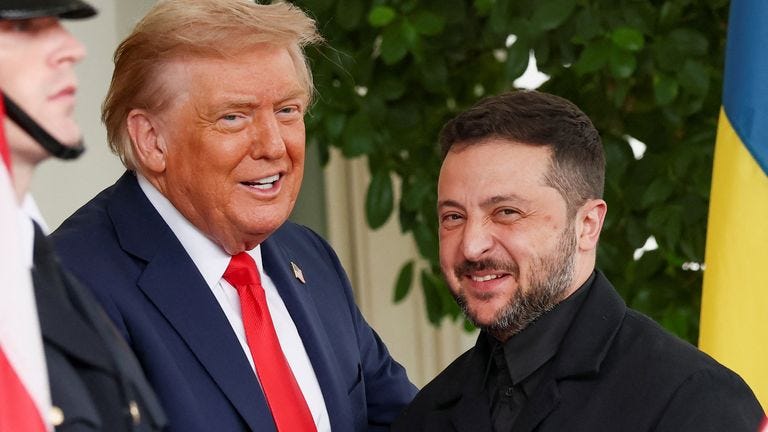
Ukrainian “dictator without elections” Volodymyr Zelensky smiling during a meeting with President Donald Trump. The president has caved to him on virtually every issue since May most recently with regards to a US “Article V like” security guarantee to go to war with Russia if Ukraine is ever attacked following the signing of a peace deal ending the current conflict.
Of course, there is no way Russia would accept such an agreement and Trump should refuse to sign such a deal as it could all but guarantee an unnecessary nuclear war even if Russia only bombs, rather than invades, Ukraine. If Trump accepts such an agreement, it will prove that he is far more of a neocon warmongering president than George W. Bush ever was.
A few months ago, Russian President Vladimir Putin asked how would the US react to long-range Russian [nuclear-capable] missiles stationed in Mexico? Why is the US placing potentially nuclear-capable missiles in Ukraine like the ATACMS and ERAM to provoke Russia to attack and destroy the US and NATO over a border dispute in the far away Russian majority Donbass region? The sad truth is that if NATO fought a war with Russia today, Russia would almost certainly lose even if the war remained non-nuclear. In a US Army War College report entitled, “A Call to Action: Lessons from Ukraine for the Future Force,” the authors concluded ”The United States sustained 50,000 casualties in twenty years of fighting in Iraq and Afghanistan. In large-scale combat operations [such as against Russia or China], the United States could experience that same number of casualties in two weeks.”
Even if a war remained entirely conventional and the Russians did not employ cyberattacks, nuclear weapons or super-EMPT weapons, the US lacks the ability to produce sufficient weapons and munitions to sustain high-intensity combat for more than a couple of weeks as confirmed by a recent article in Responsible Statecraft that notes:
As the 2025 National Security Strategy acknowledges, America lacks the industrial capacity to produce modern systems and munitions at scale and must rapidly adapt to low-cost, high-volume warfare. Ukraine is a devastating example of our material shortcomings. The U.S. has transferred more than 3 million 155mm artillery rounds – 1250% of current annual production. Rebuilding that inventory will take two years. Replacing sophisticated weapons systems is more difficult. Restoring stocks of the Javelin antitank missile would take five and a half to eight years to replenish; the HIMARS guided rocket, two to three years, and the Stinger anti-aircraft missile, six to 18 years. The Navy now operates only four shipyards, ensuring sunk warships will take years to replace. The Air Force faces similar challenges. Further complicating this problem for both branches is their lack of access to the rare-earth materials required for sophisticated weapons systems. Manpower remains a parallel crisis. The Navy is short 14,000 enlisted sailors; the Air Force 1,800 pilots, including 1,100 combat pilots.
In addition to using its vastly superior nuclear and super-Electromagnetic weapon arsenal to destroy the US homeland in the event war with NATO breaks out, Russia could also destroy all US and NATO critical infrastructure with a massive cyber and counterspace attack on the first day of major combat operations in an instant without warning leading to the entire destruction of Western civilization. So why does Trump keep provoking the Russians to attack us after spending the two years prior to his re-election warning that Biden was taking us into World War Three and pledging he would end the war in Ukraine and avert another world war immediately after returning to the White House?
America’s Nuclear Command and Control System is Vulnerable to a Russian or Chinese Nuclear First Strike
As I have been warning for the past few years, the dangers of nuclear war have never been greater due to both the increasing disparity between the size of the US nuclear arsenal and that of our nuclear-armed enemies who are allied together against us as well as the increasing propensity of US leaders to risk the outbreak of World War Three with Russia and Iran in particular that could draw in China and North Korea as well. The US policy of inviting and provoking, rather than seeking to avert, military confrontation with opposing nuclear powers has served to greatly magnify the threats to the survival of the United States and massively increase the threat to its citizens tens of millions of whom would most likely perish in such a war.
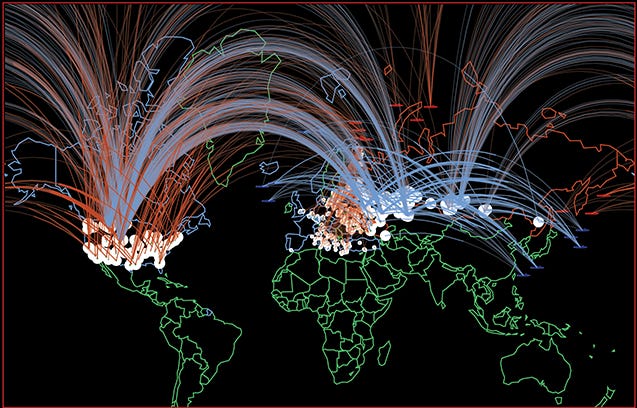
A depiction of a full nuclear missile exchange between the US and the Russian Federation but what if the US was unable to launch a nuclear retaliatory strike because its nuclear command and control system had been disabled at the onset of a Russian or Chinese nuclear first strike? Such a scenario is much more frighteningly real than most Americans realize.
The survival of the president and vice president would not be guaranteed in the event of a nuclear decapitation strike as unlike Russia and China, US leaders do not have any nuclear-proof underground command centers and if Washington, DC were to come under enemy attack, the president could have as little as five minutes to decide how to retaliate. As the recent Netflix movie, “House of Dynamite” conclusively demonstrated, depending on his whereabouts at the time of the attack that might not be sufficient time to make and communicate his decision and even if he gives the order to launch its possible that his launch order may not reach our nuclear forces. The FBI warned in 2020 that China has a Huawei cell tower in Washington, DC that has the ability not just to intercept but also disrupt a presidential launch order and US leaders have done nothing to remove it since. Furthermore, it would take at least five minutes after receipt of a presidential launch order for our ICBMs to launch and fifteen minutes for our SLBMs to launch.
An article in People magazine noted that the Nuclear Command Authority is designed to have only the President as the sole decision maker as to whether to launch a nuclear strike with a designated constitutional line of succession to replace him if he is killed.
The president of the U.S. has the full authority to launch a nuclear attack. “It depends on the scenario, but it’s true that the president doesn’t have to have his order OK’d by another person,” Duke University’s Peter Feaver told PBS News Hour. “That there’s not a two-man rule at the very top. The president alone makes the decision.” “But the president alone cannot carry out the decision,” he continued. “That decision has to be carried out be many, many people further down in the chain of command.” The president’s nuclear football contains the information needed to launch an attack. It is “carried by a military aide, and never more than an arm’s length away,” wrote Annie Jacobsen, author of Nuclear War: A Scenario, per TIME. According to The New York Times, the president must read a code known as the “nuclear biscuit” from a laminated card they always keep with them. Idris Elba, who plays the president in A House of Dynamite, reads the series of codes in the final minutes of the movie, but his actual commands are never shown. “You have such a short period of time to react, and this decision rests on the shoulders ultimately of one man,” Oppenheim told USA Today. “He does not have to build any kind of consensus; there’s not a vote. The president has the singular ability and sole authority to use nuclear weapons.”
America’s NC3 system is without a doubt the weakest link in our nuclear arsenal. While it is currently in the process of being modernized, that process is far from complete and it remains more vulnerable than ever before. US nuclear command aircraft could also potentially be taken out by super EMP attack (presuming our Looking Glass/TACAMO aircraft have not been hardened to 200,000 volts per meter which is the level of EMP emitted by super EMP warheads) or drone strikes at the onset of an enemy nuclear strike. Without our nuclear command aircraft, the Nuclear Command Authority would likely be unable to transmit nuclear launch orders to our nuclear triad.
In an article published in The Hill back in 2024, nuclear expert Ben Ollerenshaw wrote that the US is not prepared for a nuclear surprise attack on our NC3 system that could disarm us of our capability to launch a successful nuclear retaliatory strike against a nuclear aggressor not so much by destroying our actual nuclear triad but by destroying and/or disrupting our ability to transmit presidential launch orders to our nuclear triad to conduct such a strike. He suggested that Ukraine’s Operation Spiderweb which employed combat drones smuggled deep inside Russia to destroy an estimated 8-16% of Russia’s nuclear bomber fleet could be weaponized against America’s nuclear command and control aircraft necessary to transmit nuclear launch orders to our nuclear bomber, missile and submarine commanders and operators.
In his article, Ollerenshaw warns that both Presidents Joe Biden and Donald Trump have courted a protracted nuclear confrontation with Russia in Ukraine that could go nuclear with little to no warning. This could potentially end with a Russian nuclear strike against America’s nuclear command and control systems that could effectively destroy our ability to retaliate with nuclear strikes enabling Russia to use additional nuclear strikes or nuclear blackmail to swiftly defeat us with zero nuclear risks to themselves.
“We are currently in a prolonged nuclear crisis - the Ukraine War - which has been going on for well over two years and shows no sign of abating. During that time, Russian nuclear threats against NATO have become so commonplace that they no longer even constitute front page news. Judging by the history books, we have already received about as much strategic warning as we should ever hope to get.
For nearly two years now, the US has refused to respond to or even properly acknowledge Russia’s abandonment of the New START Treaty, allowing Russia to pull decisively ahead of the United States in strategic nuclear weaponry for the first time in history. The United States kept a large reserve of spare nuclear warheads as a hedge against precisely this eventuality - and those warheads are still sitting in storage today. By this policy of conscious self-sabotage, we have arrived at the worst of both worlds: the continually escalating war in Ukraine has sparked a nuclear crisis of unprecedented duration with Russia, just as unilateral disarmament has made America’s nuclear arsenal weaker, relative to its adversaries, than ever before. To put it simply, this is courting destruction.
This state of affairs is as irrational as it is dangerous. There is no effective backup to the ground alert system; none of the countless other items on the Pentagon’s budget, however well justified, will be of any value if it should fail. Today, approximately 90 percent of the defense budget is spent on non-nuclear forces, all of which would be instantly wiped out or otherwise crippled by a full-scale nuclear surprise attack. And the roughly 10 percent of the budget that is being spent on nuclear weapons will be wasted if none of these weapons can receive the order to fire.
Regardless, the present command and control situation cannot be reasonably justified even under the Administration’s policy of minimum deterrence. No matter how many nuclear weapons you think the United States should have, there needs to be somebody left alive to fire them, or the number may as well be zero. Failure to rectify the problem constitutes a reckless gamble; the stakes are the survival of the nation. Never in history has the United States been so forward - leaning abroad from a position of such deliberate, self-imposed weakness. If the gamble goes bad, it will be the American people who suffer and die as never before; so now it is up to the American people and their elected representatives to do something about it.”
Ollerenshaw notes that the cost of maintaining our NC3 system was less than one percent of our defense budget during the Cold War yet the failure of that system could leave us completely defenseless and unable to deter enemy attack including unlimited nuclear strikes on the US homeland. Yet, in 1990 the US cancelled our airborne alert system, which had been airborne 24-7 during the Cold War. Since then, a smaller fleet of ‘Looking Glass’ aircraft has been maintained on a fifteen-minute ground alert. But what if they didn’t have fifteen minutes warning to get airborne? If that was the case, then a nuclear adversary could potentially destroy these aircraft on the ground using nuclear hypersonic missiles or orbital nuclear strikes or even conventional drone strikes in the opening round of an enemy nuclear surprise attack which would render the president unable to transmit nuclear retaliatory strike launch orders to our nuclear triad before they ever take off.

View from a Ukrainian drone attacking Russian strategic nuclear bombers in a surprise attack on June 1, 2025. Experts have warned Russia could do the same thing to US strategic nuclear bombers or even our “Looking Glass” aircraft which if they were destroyed along with our underground command posts such as US Strategic Command Headquarters in Offutt Air Force Base in Nebraska could make it impossible for the US to launch its nuclear missiles.
An enemy could also potentially even use a massive nationwide super EMP or cyberattack as these aircraft may not be sufficiently hardened to withstand super EMP effects. Our nuclear command and control aircraft are based out of Tinker Air Force Base in Oklahoma and sometimes deploy to other locations as needed such as Travis AFB and Naval Air Station Patuxent River, Maryland so the number of locations an enemy would need to hit to destroy them would likely be very limited.
“Today, a modern hypersonic boost - glide missile fired from Russian territory could hit the United States in fifteen minutes - inside the margin for the ground alert aircraft. Moreover, even this inadequate window of warning could be closed by modern anti - satellite capabilities, which could take out America’s launch detection satellites before the launch of enemy missiles. But perhaps worst of all is the danger of space - based nuclear weapons, such as those advertised by Russia earlier this year. Whereas the Administration has downplayed the threat by focusing attention on the potential for orbital nuclear weapons to destroy US satellites, such weapons can also directly attack the United States - by producing EMP bursts to disable US command and control systems, and by suddenly de-orbiting to rain down and destroy them.
In either case, says Congressman Bacon, the United States would receive no usable warning at all. Dr Mark Schneider, former Principal Director for Forces Policy at the OSD and an expert in the field, agrees with the Congressman’s assessment, and stated that such attacks are probably within Russia’s current capabilities. Moreover, unlike the short - warning weapons of the Cold War era, modern boost - glide missiles and Multiple Orbital Bombardment Systems (MOBS) possess the capabilities to simultaneously destroy both the ground alert aircraft and the hardened command posts, which would decapitate the United States and leave no - one in command of US nuclear weapons.”
The question concerned US policymakers and American citizens should be asking is--Why is President Trump willing to continue to fight Biden’s proxy war against Russia in Ukraine and risk nuclear war with Russia over a border dispute between two brutal dictators in which the US has no discernible national security interest? We should be holding congressional hearings to grill Trump officials on the subject before we wake up one day with the power turned off and never have it go on again. Trump keeps escalating the war in Ukraine which he continues to denounce as Biden’s war and is “playing with nuclear fire” as Dr. Peter Pry, who served as the Founder and Executive Director of the Task Force on National and Homeland Security, presciently warned against and if he continues 250 million Americans may end up paying the ultimate price.
If President Trump is serious about ending the Russian nuclear and conventional military threat to the US and deterring Chinese aggression, he should sign an immediate peace deal with Russia to end the war in Ukraine and neutralize its alliance with the PRC. The US currently deploys two ballistic missile submarines on station in the Atlantic and two in the Pacific at any given time. Following a peace deal with Russia, he should increase the number of Ohio class nuclear ballistic missile submarines in the Pacific from two to three as they would be unable to strike the PRC from the Atlantic while at the same time mediating an EU-style confederation peace deal between China and Taiwan to avert the outbreak of World War Three in the Western Pacific.
© David T. Pyne 2026
David T. Pyne, Esq. is a former U.S. Army combat arms and Headquarters staff officer, who was in charge of armaments cooperation with the former Soviet Union, Eastern Europe, the Middle East, Africa and the Americas from 2000-2003, with an M.A. in National Security Studies from Georgetown University. He is the former President and current Deputy Executive Director of the Task Force on National and Homeland Security. He recently served as Defense and Foreign Policy Advisor to former Republican presidential candidate Vivek Ramaswamy. He has also co-authored the best-selling new book, “Catastrophe Now--America’s Last Chance to Avoid an EMP Disaster” and his new book “Restoring Strategic Deterrence” will be published in January 2026. He serves as the Editor of “The Real War” newsletter at dpyne.substack.com and previously served as a contributor to “The National Interest”. Here is a link to his interview archive. He also posts multiple times a day on X at @AmericaFirstCon. He may be reached at emptaskforce.ut@gmail.com.
Recent Interviews
January 7th—Interview with Brannon Howse on Brannon Howse Live to discuss Trump’s lies about Maduro being a cartel drug lord to justify his attack on Venezuela and the US seizure of a Russian tanker in the North Atlantic and why Trump is right to want to take over Greenland.
January 9th—Interview with Brandon Weichert on his National Security Talk podcast to discuss the latest with regards to the war in Ukraine, China’s joint air naval blockade exercises surrounding Taiwan and Trump’s attack on Venezuela and removal of Venezuelan President Nikolas Maduro from power.
January 15th—Interview with Brannon Howse on Brannon Howse Live to discuss Trump’s purported plan to bomb Iran in an attempt to overthrow its Islamic regime in support of the opposition members protesting against the regime. We will also talk about Trump’s threat to annex Greenland one way or the other—the hard way or the easy way.
January 20th—Interview on Main Street Radio with Jon Twitchell on his Talk with Jon show to discuss the latest news regarding the war in Ukraine, China’s plans to blockade and/or invade Taiwan and Trump’s plan to overthrow the Maduro regime in Venezuela.
January 26th—Interview with Brandon Weichert on his National Security Talk podcast to discuss the latest with regards to the war in Ukraine, Trump’s attempt to gain control of Greenland and his seeming march to war with a nuclear-armed Iran.
January 27th—Panel Discussion with Jon Twitchell and Michael Letts on Main Street Radio on the Talk with Jon Show to discuss the latest news regarding Trump’s attack on Venezuela and his planned bombing strikes against Iran that could provoke a massive cyberattack on the US homeland as well as the ICE protest in Minneapolis.
February 2nd—Interview with COL Rob Maness on the Rob Maness Show to discuss Trump’s Board of Peace and his failed attempt to annex Greenland as well as Trump’s continued threats to bomb Iran and start World War Three.
February 2nd—Interview with Brannon Howse on Brannon Howse Live to discuss the latest on Trump’s plan to bomb Iran, the danger of a Carrington Event level super geomagnetic storm in the near future and what the US should have done differently during World War Two.
February 3rd—Interview on the Kianistan podcast with Tafhim Kiani to discuss U.S. National Security, Strategic Threats & Global Conflict Risks including Greenland, Venezuela, Iran, Ukraine and Trump’s long-terms plans for transforming the bipolar international order to a new tripolar international order with Russia and China.
Upcoming Interviews
February 16th—Interview with Brannon Howse on Brannon Howse Live to discuss whether Trump will go through with starting a new regional war with Iran and Trump’s misleading claim he rebuilt the US nuclear arsenal to be the largest and most powerful in the world.
February 17th—Interview on Main Street Radio with Jon Twitchell on his “Talk With Jon” podcast to discuss the latest news regarding Trump’s plans to start a war with Iran, progress negotiating an end to the war in Ukraine, Trump’s reported commitment to go to war with Russia to defend Ukraine and his claim that the US has the strongest nuclear arsenal in the world.
I voted for him three times. Always a long shot.
We are totally screwed!
We will all become totally captured. If they’re able to live, our great grand children will become their prey.
And they will be asking how did we let this happen??
It happened because of the bread and circuses. It’s an old story…
Thank you, David.
I expect you've read the late Daniel Ellsberg's last book "The Doomsday Machine: Confessions of a Nuclear War Planner"? If so, what's your view of his extensive discussions of the delegation of nuclear launch authority (since Eisenhower), initially to theater commanders, but ultimately de facto to nuclear platform commanders (indeed for both the USA and Russia), even down to individual pilots / submarine commanders?