
Trump’s National Security Strategy Shows How to Transform US from an Empire to a Republic
Transitioning the US from a global empire back to a constitutional republic and hemispheric superpower could help ensure a just and lasting peace with Russia, China, Iran and North Korea.

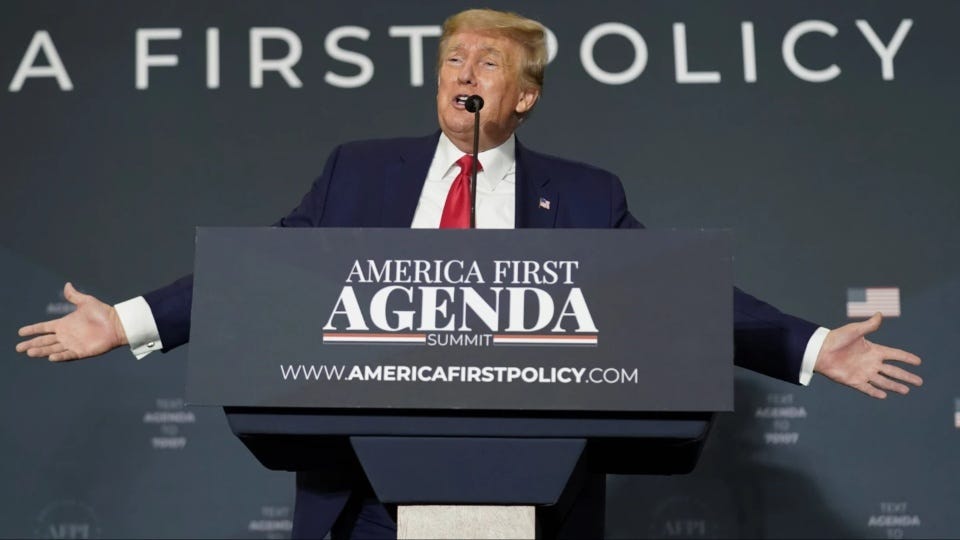
President Donald Trump ran as a platform of putting America First. While he has largely done that in terms of his domestic and trade policies, his foreign policy over the past eight months has been far more in line with George W. Bush’s and John McCain’s than Ronald Reagan’s, let alone pre-World War Two Republican Presidents like William McKinley and Theodore Roosevelt.
As I wrote in one of my last articles, the Trump administration has published an outstanding new National Security Strategy which commits the US to prioritize the defense of the US homeland and reasserting US dominance and reversing Russian and Chinese influence in the Western Hemisphere. It offers the best possible official US government blueprint yet published as to how to transform the US from a global empire that fights endless, unnecessary wars of aggression back into a constitutional republic which was the form of government gifted to us by our Founding Fathers that promotes world peace and stability as the US was before the outbreak of World War Two with the exception of US involvement in World War One from 1917-1918.
President Donald Trump’s recent moves against Communist Venezuela and his call for the US to annex Greenland along with his threats against Communist Cuba have been in execution of this bold, courageous and visionary foreign-policy realist strategic vision as was the recent US withdrawal of a full Army brigade from Romania. But his failure to end NATO’s proxy war against Russia in Ukraine with a negotiated peace agreement and his continuing threats to bomb Iran to punish its Islamist regime for killing an estimated 2,000-3,000 of the one million Iranian protesters who the CIA recruited to attempt a failed color revolution against Tehran run counter to his declared strategy.
President Trump’s Greenland Gambit
President Trump has spent his first year in office musing about annexing Canada and Greenland and retaking control of the Panama Canal but of these three announced territorial objectives, his focus over the last few months has been on taking control of Greenland which would be the easiest for him to accomplish as US military forces could be surged in Greenland and occupy its capital city of Buuk within half an hour. On January 6th, Danish Prime Minister Mette Frederiksen warned an American takeover of Greenland would amount to the end of the NATO military alliance and she is likely not mistaken as Denmark could invoke Article Five of the Atlantic alliance against the US. Some of America’s NATO partners went so far as to send dozens of troops to Greenland in a show of solidarity against the US and against President Donald Trump in particular.
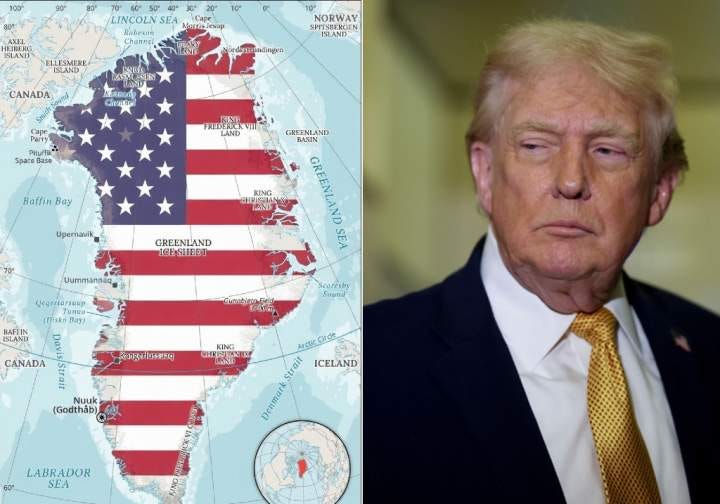
Annexing Greenland has been Trump’s greatest dream, other than making Canada the 51st state which would likely run into far more political opposition, but Trump appears to have given up that dream to avoid a clash with America’s NATO frenemies many of whom have vowed to wage war with the US to defend the Danish territorial possession from a US military takeover.
Trump has since conceded that his plan to take Greenland may end up being a choice between taking over the huge strategic island or keeping NATO alive. He noted the existential threat to NATO last week, telling The New York Times that “it may be a choice” between forging ahead with his ambition to seize control of the Arctic island and keeping the military alliance intact. Though he didn’t say which of the two options he favored, Trump did give an insight into his thought process, saying he felt that controlling Greenland was “psychologically needed for success.” Clearly, he would prefer the first option but his neocon advisors, including the Joint Chiefs of Staff, appear to have talked him out of taking control of the island to save NATO which I believe to be a major mistake.
Why Does Trump Want Greenland?
The primary reason that President Trump has been so adamant about the US annexing Greenland is that he wants to be remembered as the president who annexed a huge swath of the territory almost as large as what the US annexed from Mexico from 1945-1848 that would cause the US overtake Canada as the second largest country in the world in terms of territory with nearly twenty-three percent more territory that it currently has. Trump has invoked comparisons to President James K. Polk who presided over that vast acquisition of territory seeming to imply it is part of America’s Manifest Destiny—namely that the US has a divine right to expand its territory across North America--to acquire it. During the Polk’s administration, the United States annexed over 1.1 million square miles of territory, primarily through the annexation of Texas, the Oregon Treaty, and the Mexican American War. This expansion included significant areas that would become California, Nevada, Utah, New Mexico, and parts of several other states. Trump has infamously also called for the US annexation of Canada which he has often referred to America’s 51st state.
Certainly, there are strategic reasons for the US to want to take control of Greenland primarily relating to US missile defense in terms of both ground-based radars to provide more resilient detection and tracking of Russian nuclear missile launches and potentially Ground Based Interceptors to shoot them down but that is the biggest reason. In addition, Russian nuclear-equipped naval forces including both surface ships and submarines must travel through the Greenland-Iceland-UK gap and US control of Greenland would increase US control over those straights in the event of the outbreak of a world war with Russia which the Trump administration correctly believes is highly unlikely to materialize.
The window is closing for President Trump to take control of Greenland and make it a US commonwealth to prevent our NATO frenemies from trying to stop us by deploying token numbers of troops in a symbolic show of solidarity against the undisputed leading power of the Atlantic Alliance. Trump should abandon his attempts to risk a Third World War by bombing the Islamic Republic of Iran, that could provoke them to use a massive cyberattack to destroy all US critical infrastructure and kill tens of millions of Americans and should take the opportunity for an easy double win by annexing Greenland and ending NATO in a single day.
If President Donald Trump were to invade Greenland, which the US could conquer very swiftly and decisively, collapse NATO and subsequently agree to a lasting bilateral peace deal with Russia ending the war in Ukraine, he would likely be remembered as one of America’s greatest presidents. In all honesty, I think it could be one of the best ways for him to rehabilitate his presidential legacy were he to refrain from further uses of US military forces thereafter. Furthermore, a US exit from NATO would allow us to withdraw all our troops from Europe saving us $100 billion a year and allow the Europeans defend themselves for the first time in eighty-five years giving us a lasting peace with Russia making us more safe and secure and making the Europeans independent from their near century long imperial benefactor. All told, it would serve as a major “win-win” triumph for America First!
On January 21st, Fox News reported that Denmark rejected President Trump’s bid to buy Greenland for $700 billion reported earlier this week and that he has given up his demand that Greenland be sold to the US. Trump has accepted a proposal issued by NATO General Secretary Mark Rutte whereby the US would recognize Denmark’s indefinite sovereignty and full control over Greenland in exchange for increased US military basing rights and mineral development. Trump’s decision to cave to our NATO frenemies who threatened to defend Greenland against the US by military force after Trump underscored the strategic necessity of the US acquiring Greenland has made him look especially weak.
Fox Business reported on his interview with Fox News host Maria Bartiromo:
“Based upon a very productive meeting that I have had with the Secretary General of NATO, Mark Rutte, we have formed the framework of a future deal with respect to Greenland and, in fact, the entire Arctic Region,” Trump wrote on social media. “I mean, we’re talking about, it’s really being negotiated now, the details of it, but essentially it’s total access. There’s no end, there’s no time limit,” Trump responded. “We’re getting everything we want at no cost.” Asked if the US would ultimately acquire Greenland, he said: “It’s possible. But in the meantime, we’re getting everything we wanted, total security.”
On January 22nd, Trump announced that he would not take any military action to take control of Greenland and that he was dropping his announced tariffs on Denmark and 7-8 other NATO frenemies stating that the Greenland framework agreement negotiated between himself and NATO Secretary General Mark Rutte was a great deal for the US and NATO. According to Rutte, the question of increasing the US military presence in Greenland was not discussed nor was the question of Denmark giving up its sovereignty over the world’s largest island which includes over 836,000 miles of territory. The Joint Chiefs of Staff reportedly opposed Trump’s plan to occupy Greenland stating that such a move would likely not be approved by Congress.
The specific terms of the US-NATO framework agreement reportedly include 1. The U.S. will gain control of “Small, small pockets of land” in Greenland 2. The U.S. will be involved in Greenland’s mineral rights Greenland is estimated to hold reserves of natural resources worth as much as $5 trillion. 3. The U.S. “Golden Dome” system will be involved in Greenland when it’s built 4. The deal is designed to block Russian and Chinese influence in Greenland 5. This will open the door to US-backed infrastructure investment 6. The duration of the deal will have an “indefinite” timeframe.
However, on January 22nd, Denmark’s Prime Minister, Mette Frederiksen, stated that Denmark was not a party to the agreement and that Denmark would not be ceding any Greenlandic territory to the US. She has confirmed that the Greenland framework agreement does not cede any territory to the US. Trump has been stating for months that he would settle for nothing less than full control of Greenland and now he’s saying this agreement would be in force for an indefinite period of time meaning that Denmark would continue to control Greenland indefinitely.
With Trump having pledged not to use military force to retake control of Greenland which was occupied by the US from April 1941 to May 1945, the only other way he could get Denmark to give it up is if he enacts massive tariffs against Denmark and the 7-8 NATO frenemies that sent troops to Greenland. Alternatively, he could enact 100% secondary tariffs on any nation that continues to trade with Denmark to crash their economy if they don’t agree to sell it to us. That would force the Danes to give it up quickly without the need for military force or a US naval blockade of Denmark. Then, the US could make Greenland a US Commonwealth with perpetual self-rule like Puerto Rico, pay each Greenlander $100,000 each and Trump would get the credit for making the US the second largest country in the world. As Trump has stated, it would be a great deal not just for the US but for Greenland as well.
Tucker Carlson Calls on US to Ally with Russia
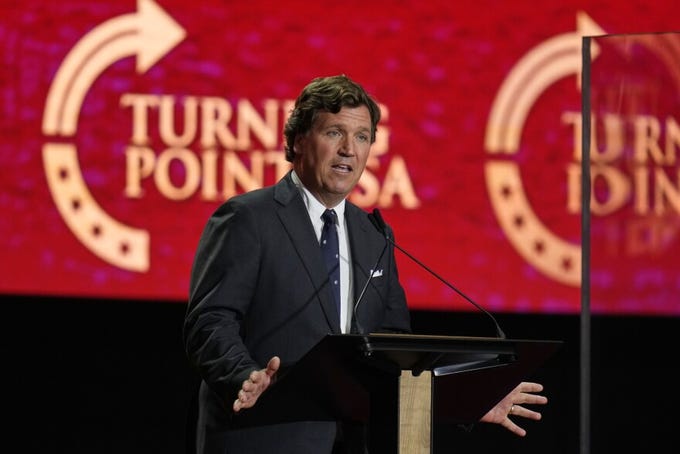
America First conservative hero and former Fox News host Tucker Carlson who has been a courageous voice for peace and Christian moral values and has been proven right on virtually all issues concerning foreign policy and war over the past several years.
America First conservative champion Tucker Carlson recently echoed foreign policy realist scholar Dr. John Mearsheimer’s call for the US to ally with the Russian Federation to break up the Sino-Russian military alliance which he correctly identifies as an existential threat to the United States which we would have no realistic chance of defeating in war. I have long stated that one of the five biggest mistakes that the US made in losing the post-Cold War peace was failing to invite Russia into NATO and instead expanding NATO to Russia’s borders in eastern Europe to provoke it to ally with the People’s Republic of China. Tucker Carlson stated:
“If Putin is our enemy, if Russia is our enemy, we cannot survive a global conflict. NATO is done. Once United States takes Greenland, which is owned by a fellow NATO member, what will be the rationale for keeping NATO? The United States has to have a relationship with Russia in order to survive anything like that.” “If Donald Trump wants to commit one act as president that will secure him a place in history forever, as a hero, it would be to bring Russia back into alliance with the United States. Russia is essential to the United States. We cannot survive a global conflict if Russia and China are aligned against us. Period. There’s no reason to pay any attention to the unelected leader of Ukraine.”
Isn’t it interesting that for half a century neocon Republicans have propagandized us into falsely believing that allying with the genocidal Evil Soviet Empire and arming them to the teeth with 23,000 tanks and armored fighting vehicles, 15,000 combat aircraft and half a million trucks and jeeps to help them conquer half of Europe and Northeast Asia was both justified and necessary for us to win World War Two? They also continue to justify FDR and Churchill’s decision to reward Soviet leader Josef Stalin, then the most murderous dictator in world history by far, with control of the eastern half of Europe as part of the shameful Yalta Appeasement Pact. But these same neocons now assert that allying with post-Soviet Russia, which gave up its entire empire consisting of twenty captive nations, and has never made any serious attempt to take any of them back, for the purpose of massively enhancing US national security, neutralizing the Sino-Russian military alliance and promoting world peace, would somehow be immoral and unthinkable.
In addition to this, it must be remembered that it was the neocons that championed the policy of providing the PRC with trillions of US taxpayer subsidies to vastly expand their nuclear arsenal and conventional military forces. Prior to that, they supported Ronald Reagan’s decision to provide a billion dollars in direct US military aid and advanced avionics military technology to Communist China despite the fact it was and continues to be the most murderous regime in world history. The common denominator here is that the neocons have a long record of supporting Communist tyrannical regimes and generally opposing any action which might serve to seriously weaken global Communism for which they appear to have some ideological affinity. This is why they despise principled anti-Communist, America First conservatives like me.
Exiting NATO and Forming a New Triple Entente with Russia and India to Counter Communist China
Perhaps the biggest way for the US to move from an empire back to a republic would be a US exit from the NATO alliance which with its March-June 1999 bombing of the former Yugoslavia and subsequent revision of the borders of Europe by force of arms amputating Kosovo from Christian Serbia transformed from a purely defensive alliance to an alliance of aggressors. I have been calling on President Trump to pull US out of NATO since 2019 on the grounds that I believe it serves as a noose around America’s neck threatening to pull us down into the abyss of an unnecessary nuclear war with Russia our great nation would be highly unlikely to survive. President Trump himself reportedly stated in 2018 that he wanted the US to withdraw from NATO, an alliance which he rightly derided as obsolete, only to be dissuaded from that excellent course of action by his Deep State advisors like former National Security Advisor John Bolton. Reshaping NATO into an entirely European-led alliance should be Trump’s number one objective which is why Trump should absolutely use his drive to get Greenland to declare independence from Denmark to do so. NATO is obsolete and US membership in NATO makes the US far more insecure by putting a Russian nuclear bullseye on the US homeland.
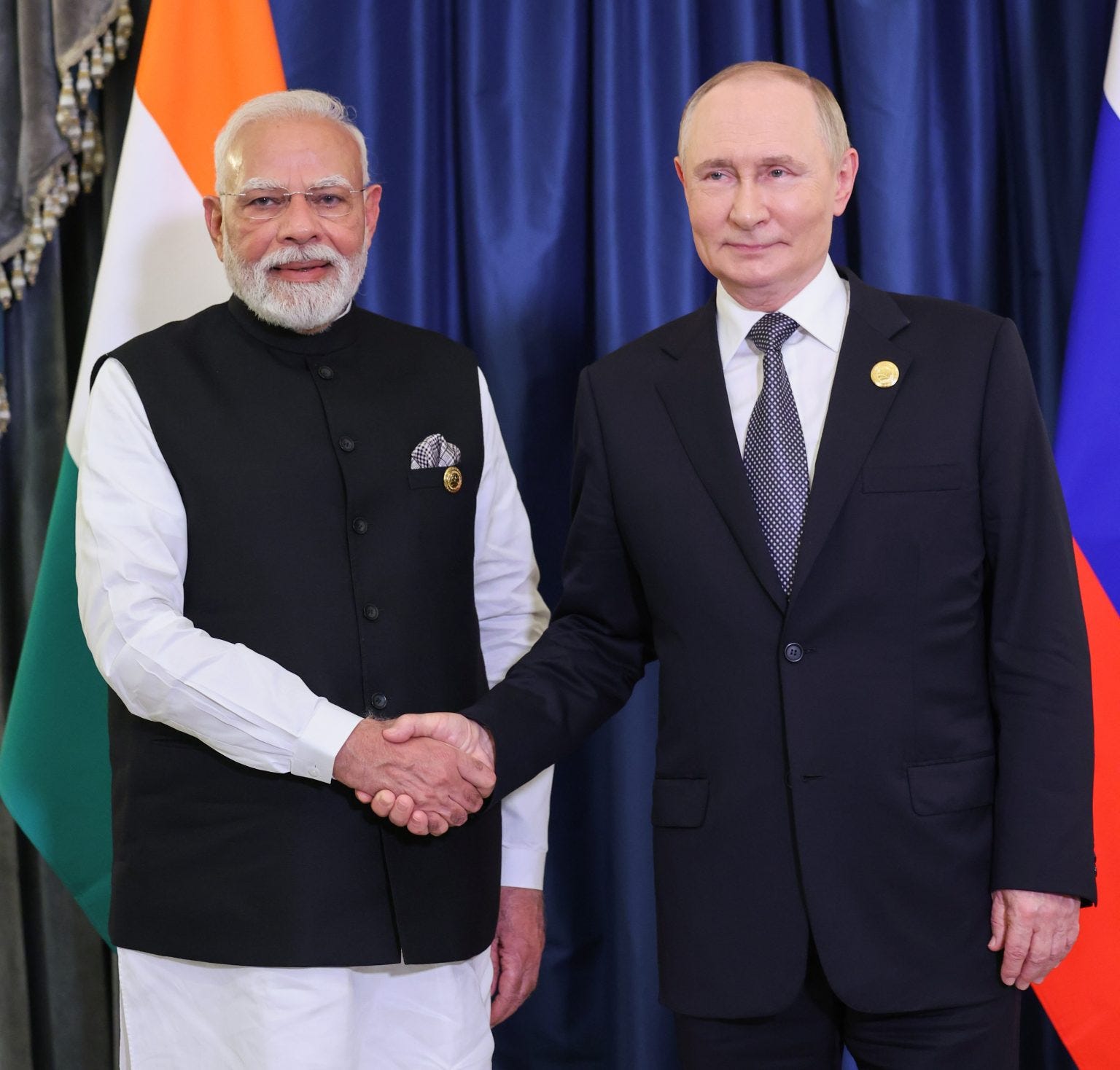
Indian President Narendra Modi shaking hands with Russian President Vladimir Putin during a recent summit meeting. Today, Russia and India are allied with the People’s Republic of China against the US under the banner of the Shanghai Cooperation Organization which Putin has described as “a Warsaw Pact reborn.” But if Trump could get both military giants to ally with the US instead, Communist China could be gravely weakened.
Before World War One, Britain, France and Russia formed a quasi-military alliance known as the Triple Entente which did not become a full-scale military alliance at least as far as the UK was concerned until after war broke out with Imperial Germany and Austria-Hungary. The time has come to revive the idea of a new security alignment for the US not with NATO, which while it has grown to include a number of small Eastern and Southern European countries over the past 27 years, has become militarily weaker and increasingly obsolete since the collapse of the Soviet Union, but with Russia and India. President Trump should act to more fully implement his outstanding new National Security Strategy by forming a modern-day Triple Entente with Russia and India to massively strengthen US national security while neutralizing Russia’s military alliance with the PRC. The US would be far stronger and more secure with Russia, the mightiest nuclear power in the world by far, and India, the country with the largest population and the second largest military, as economic and security partners to deter potential future Chinese aggression than the much weaker and increasingly irrelevant member states of the European Union. The US would be far better off to align with Russia and form a modern-day Triple Entente between the US, Russia and India to counter the PRC instead of continuing to have it as an enemy of our own making. If we were to pull out of NATO and align ourselves with Russia and India, then the existential threat of a Russian nuclear/super EMP first strike on the US would disappear overnight and the US could effectively neutralize its military alliance with Communist China.
President Trump has announced his intention to increase the US military budget to $1.5 trillion which equates to 4.9 percent of our 2025 GDP a stunning reversal from his statements back in March when he declared his desire to cut US military spending by 50 percent after ending the war in Ukraine and achieving lasting peace deals with both Russia and China. What he seems not to realize is that US security is not dependent upon how much the US spends on its defense budget but rather how far the US is going to provoke our enemies to attack us. The US would be far better off to negotiate peace deals with Russia over Ukraine and with China over Taiwan, withdraw from NATO’s military command structure, withdraw US troops from Europe, form a strategic partnership if not an entente with Russia and India, and seek a durable peace with Iran. Then, the US could invest more in homeland, strategic and hemispheric defense, spend less on its military and make the US far safer and more secure than it has been since the Soviets deployed their first nuclear strategic bomber in 1951. On January 9th, the Vice President of France’s National Assembly, Clemence Guette, announced she was introducing a resolution for France to withdraw from NATO starting with France’s withdrawal from NATO’s military command structure, to restore France’s strategic autonomy following Trump’s actions against Denmark and Venezuela. France withdrawing from NATO’s military command structure would provide a great opportunity for the US to follow suit.
President Donald Trump has taken a very positive step by announcing the withdrawal of the US to withdraw from 31 United Nations organizations and dozens of other international organizations of dubious organizations. Now, President Trump should take the next logical step by first defunding the United Nations and then pulling the US out of the godless, Marxist-led, anti-American United Nations which is something I have been supporting for the past forty years. In its place, as reportedly suggested in the larger classified version of the Trump administration’s National Security Strategy, we should form a new Core 5 (C5) grouping to replace the G-7 consisting of the top five core world economic powers as reportedly planned by the Trump administration.
Alternatively, we could form a G-9 consisting of the eight declared nuclear powers--the US, Russia, UK, France, China, India, Pakistan and North Korea along with Israel, which is known to be a nuclear power, which together constitute the only ‘great powers’ in the world today. We could also potentially include the Islamic Republic of Iran in this great power grouping were they to disclose the existence of its modest nuclear missile arsenal in the near future. The purpose of this organization would be to peacefully resolve international disputes to avoid unnecessary military conflicts around the world. Meanwhile, European nations could form a new Concert of Europe which would include the seven largest European countries of Russia, Turkey, Germany, the United Kingdom, France, Italy and Spain for the purpose of peacefully resolving European disputes.
What Trump’s New National Security Strategy Means for Russia, Ukraine and Europe
While President Trump’s excellent new strategic guidance does not specifically mention Russia’s invasion of Ukraine, it states that the primary focus of America’s strategy with Russia should be the restoration of strategic stability which would require the US to end NATO’s proxy war against Russia in Ukraine on terms minimally acceptable to Russia as well as the normalization of diplomatic and trade relations with Russia. The NSS states that the U.S. seeks an “expeditious cessation of hostilities in Ukraine” to stabilize Europe and reestablish strategic stability with Russia.
Trump’s National Security Strategy calls for halting NATO expansion, promoting resistance to current European course, and treating Russia as competitor rather than enemy while criticizing European governments for “unrealistic expectations” about Ukraine war. The Trump administration’s newly released U.S. National Security Strategy 2025 asserts that an “expeditious cessation of hostilities in Ukraine” is a core U.S. interest—not only to enable Ukraine’s survival as a “viable state,” but also to stabilize the European economy, prevent escalation and reestablish strategic stability with Russia. Managing Europe’s relationship with Russia, the NSS notes, will require vigorous U.S. diplomatic engagement to avoid further conflict and promote Eurasian stability. The document calls for “reestablishing conditions of stability within Europe and strategic stability with Russia,” thus, highlighting nuclear arms control. On nuclear policy, the strategy promises America the “world’s most robust, credible and modern nuclear deterrent,” alongside investment in “next-generation missile defenses.”
Reportedly, the Trump administration is planning to negotiate multi-trillion-dollar economic deals with Russia on energy and rare-earth cooperation once this has been achieved. Meanwhile, President Trump issued Ukrainian President a deadline of Christmas Day and previously issued him a deadline of Thanksgiving Day to agree to peace to make peace with Russia but Trump allowed both deadlines to pass with zero consequences. Zelensky has made no concessions on the road to peace with Russia since Trump took office so Zelensky will likely continue to assume that Trump will do nothing if he refuses to make peace.
However, President Trump declined to sign the reconstruction agreement at the Davos summit meeting. One source reported that the signing of the agreement as well as expansive new US security guarantees contained in a 15 year security agreement with Ukraine was conditioned upon Zelensky’s agreement for peace along the Anchorage Summit formula specifically his agreement to cede control of the eleven percent of the Donbass region still controlled by Ukraine back to Russia. Zelensky has repeatedly refused to consider such a concession while Putin has stated that the war will continue until Russia has achieved full control of the Donbass either by diplomacy or by force.
The Ukraine War has had the perverse effect of increasing Europe’s, especially Germany’s, external dependencies. Today, German chemical companies are building some of the world’s largest processing plants in China, using Russian gas that they cannot obtain at home. The Trump Administration finds itself at odds with European officials who hold unrealistic expectations for the war perched in unstable minority governments, many of which trample on basic principles of democracy to suppress opposition. A large European majority wants peace, yet that desire is not translated into policy, in large measure because of those governments’ subversion of democratic processes. This is strategically important to the United States precisely because European states cannot reform themselves if they are trapped in political crisis. One of the priorities laid out by the NSS is “Ending the perception, and preventing the reality, of NATO as a perpetually expanding alliance.”
The NSS is very critical of European NATO’s for trying to sabotage all of President Trump’s attempts to end the war in Ukraine and support sacrificing hundreds of thousands of brave Ukrainian soldiers to die in an unwinnable war against Russia in opposition to the will of the people of their own countries with the exception of the UK where a majority of British subjects have been propagandized into supporting NATO’s proxy war against Russia. Meanwhile, the Trump administration pledges to recognize Russia’s security interest in preventing further eastward expansion by the NATO alliance into Ukraine or the Caucuses.
The issuance of the Trump National Security Strategy and a demand for Europe to take over its own conventional defense is a perfect opportunity for Trump to implement his plan to remove the US from NATO’s military command structure just as France did in 1966 while continuing to remain a member of NATO. If he did that, then any remaining US military forces would remain under the command of US military commanders, but NATO members would be made to understand that if one or more NATO countries attacked Russia or if Russia attacked the Baltic states, the US would stay out of a direct war with Russia.
It is expected that the National Defense Strategy will also be released later this month and that it will be fully in line with the administration’s recently issued National Security Strategy including a call for a global realignment of US military forces. Reportedly this will include a major reduction in US military forces from Europe (beginning with the recently announced withdrawal of a US Army brigade from Romania) and potentially the Middle East and South Korea.
In an article in The Stars and Stripes, entitled “US sets deadline for Europe to lead NATO by 2027, report says,” it reveals that the Trump administration has given our European NATO allies a deadline of 2027 to assume principal responsibility for the conventional defense of Europe suggesting the US plans to withdraw most of its ground forces from Europe by that time.
The U.S. has told European allies it wants Europe to assume most of NATO’s conventional defense responsibilities by 2027. The message, delivered in meetings with European diplomats, warned that Washington may withdraw from some NATO planning roles if Europe doesn’t make enough progress—though the U.S. has not defined how progress will be measured. European officials say the 2027 goal is unrealistic.
As I have noted, this may be a prelude to the US not only transferring the Supreme Allied Commander position from a US general to a US, British or French general but also for the US to remove itself from the NATO military command structure just as France did back in 1966. The message being sent of course is that the US would not go to war in support of our European allies if they stumbled into a direct war with Russia but would respond the same way we have responded to Russia’s invasion of Ukraine by sending arms but no troops to help them defend themselves.
This lack of self-confidence is most evident in Europe’s relationship with Russia. European allies enjoy a significant hard power advantage over Russia by almost every measure, save nuclear weapons. As a result of Russia’s war in Ukraine, European relations with Russia are now deeply attenuated, and many Europeans regard Russia as an existential threat. Managing European relations with Russia will require significant U.S. diplomatic engagement, both to reestablish conditions of strategic stability across the Eurasian landmass, and to mitigate the risk of conflict between Russia and European states. It is a core interest of the United States to negotiate an expeditious cessation of hostilities in Ukraine, in order to stabilize European economies, prevent unintended escalation or expansion of the war, and reestablish strategic stability with Russia, as well as to enable the post-hostilities reconstruction of Ukraine to enable its survival as a viable state.
The only statement in the NSS that I take a major exception to is its assertion that our European partners have a major advantage in hard power over Russia. Indeed, Russia not only spends more than all thirty of our European allies on its military by Purchase Power Parity, it also has a much stronger defense industrial base and far more robust conventional military than they do, not to mention a nuclear arsenal that far exceeds that of the US and its allies.
Stars and Stripes reports that it could take years for America’s NATO partners to fill the gap from the reduction, if not elimination of US air and ground forces in Europe.
Still, security analysts have noted that it will take years for allies in Europe to develop the capabilities the U.S. brings to the table. An American military withdrawal from Europe by 2027 could leave capability gaps. Indeed, if NATO had to go it largely alone in the event of a Russian attack, European allies would face a daunting challenge, experts say. At a minimum, it would need to field 50 new combat brigades and some 300,000 troops to offset the loss of U.S. support, according to an analysis earlier this year by Bruegel, a Brussels-based think tank. To prevent a rapid Russian breakthrough in the Baltics, for example, Europeans would need a minimum of 1,400 tanks, 2,000 infantry fighting vehicles and 700 artillery systems, the February report said. “This is more combat power than currently exists in the French, German, Italian and British land forces combined,” the report stated. Europeans also would need to surge beyond the “barebones stockpiles” of munitions currently available. An estimated 1 million 155 mm shells would be the minimum for a stockpile large enough for 90 days of high-intensity combat, the report said.
In addition, it has been reported that Secretary of War Pete Hegseth has an outstanding new plan which would massively overhaul the US military command structure. The UK Independent reports that the plan would see the elimination of three US combatant commands. The plan would keep Indo-Pacific Command intact, but merge Northern and Southern Commands into a US America’s Command (AMERICOM) and merge US European Command, Central Command and Africa Command into a new US International Command massively deprioritizing Europe, the Middle East and Africa which would be regulated to our lowest national security priority.
Taken together, the reorganization would shrink the number of combatant commands from 11 to eight, while also reducing the number of four-star admirals and generals who answer directly to Hegseth. The other existing commands would remain untouched. These are: U.S. Indo-Pacific Command, U.S. Space Command, U.S. Special Operations Command, U.S. Transportation Command and U.S. Strategic Command. People with knowledge of the proposal told the Post that it compliments Trump’s recently released national security strategy, which took aim at long-established U.S. allies in Europe, claiming their governments are failing to uphold the will of their people. It also stated that the “days of the United States propping up the entire world order like Atlas are over.”
The White House’s new National Security Strategy states that “NATO cannot be an alliance in perpetual expansion” and that it’s in the U.S. national interest to negotiate a rapid cessation of hostilities in Ukraine to prevent escalation and restore strategic stability with Russia. Having a US National Security Strategy that formally renounces NATO expansion eastward and negotiating a swift end to the war in Ukraine is a very welcome change in US policy from the Trump administration. So now can we expect President Trump to suspend our “massive weapon shipments” to Ukraine following the issuance of this excellent new National Security Strategy to prevent further escalations of Biden’s proxy war with Russia in Ukraine and restore strategic stability in Europe? So far, we have seen no change in Trump’s Ukraine policy of continuing to appease Zelensky and EU leaders and refusing to negotiate a peace deal ending the war directly with Russia. Even so, Russian government officials have expressed approval of the new US security strategy and Russian President Vladmir Putin has openly asked if the US as the leader of NATO does not consider Russia an enemy then why do many of Europe’s NATO members continue to threaten war with Russia?
The new National Security Strategy calls for the need to “cultivate resistance to Europe’s current trajectory within European nations” of more socialism, censorship, mass immigration from the Middle East and war with Russia. I’m open to promoting regime change in Europe by peaceful means. Nothing would promote peace more effectively than using peaceful means to replace the warmongering anti-Trump regimes in Kyiv. London, Paris and Berlin with populist, pro-peace, democratic. nationalist, conservative leaders. We know that the UK Starmer government dispatched 100 British election experts during the 2024 presential election to help former Vice President Kamala Harris defeat President Donald Trump. Perhaps, the US should return the favor by interfering in future UK elections on behalf of the UK Independence Party of Nigel Farage. Of course, I support the peaceful overthrow of Communist and Marxist regimes in Latin America as well.
Trump’s Newly Released National Defense Strategy
The Trump administration’s 2026 National Defense Strategy (NDS) was released last night by the White House via email to the media with zero fanfare much as was done with the release of the National Security Strategy (NSS) early last month. This represents a stark contrast to the rollout of Trump’s 2018 National Security Strategy following which the Department of Defense held a press conference to brief it to the public. One almost gets the impression that the administration is ashamed of its own NDS and NSS. The NDS features four key lines of effort under the Department’s Strategic Approach: Defend the U.S. Homeland; Deter China in the Indo-Pacific Through Strength; Not Confrontation; Increase Burden-Sharing with U.S. Allies and Partners; and Supercharge the U.S. Defense Industrial Base.
The Pentagon on Friday night released a long-awaited strategy that prioritizes the U.S. homeland and Western Hemisphere — a stunning reversal from previous administrations that aligns with President Donald Trump’s military strikes in Venezuela and efforts to acquire Greenland. The National Defense Strategy — a dramatic shift from even the first Trump administration — no longer focuses primarily on countering China. Instead, it blames past administrations for ignoring American interests and jeopardizing the U.S. military’s access to the Panama Canal and Greenland. The strategy calls for attention to the “practical interests” of the U.S. public and an abandonment of “grandiose strategies.” The Pentagon’s plan, in contrast to the National Security Strategy released last month, does not focus heavily on Europe or call the continent a place in “civilizational decline.” But it does emphasize what the administration perceives as its declining importance. “Although Europe remains important, it has a smaller and decreasing share of global economic power,” according to the strategy. “Although we are and will remain engaged in Europe, we must — and will — prioritize defending the U.S. Homeland and deterring China.”
George Beebe, former Director of Russia analysis on the National Security Council, who now serves as Director of Grand Strategy at Responsible Statecraft, noted in a recent interview before the NDS was published that European NATO member states had become a drain on US national security because of their inability to provide for their own defense and their continual attempts to sabotage Trump’s efforts to end NATO’s proxy war against Russia in Ukraine. He said that needs to change if the US is to remain a member of the Atlantic Alliance and that the US needs allies that are “force multipliers” rather than run counter to US national security interests as our NATO partners like the UK, France and Germany in particular are currently doing.
The document, which usually follows the National Security Strategy, came out after months of delay. POLITICO reported in September that a draft had reached Defense Secretary Pete Hegseth’s desk. But it stayed there for months as administration officials fought over how to describe the threat to the U.S. posed by China amid trade talks with the country. The strategy also says the U.S. should “no longer cede access or influence over key terrain in the Western Hemisphere,” including the Gulf of Mexico. But it offers few details on how the Pentagon will accomplish that goal. The first Trump administration prioritized China in its 2018 defense strategy as the biggest threat to U.S. security. That sentiment was further echoed in the Biden administration’s 2022 strategy. But the 2026 strategy instead highlights a continued U.S. focus on diplomacy with China — an echo of its recent annual report on Beijing’s military buildup — while “erecting a strong denial defense” in the Pacific to deter a potential war. It does not lay out what U.S. assets the Pentagon might send to the region. The document mentions threats to the U.S. from Russia, Iran and North Korea, but they are not as prominent.
https://www.politico.com/news/2026/01/23/pentagon-national-defense-strategy-00745499
Under the U.S. Department of Defense’s 2026 National Defense Strategy, Russia “will remain a persistent but manageable threat to NATO’s eastern members for the foreseeable future… The Department will ensure that U.S. forces are prepared to defend against Russian threats to the U.S. Homeland. The Department will also continue to play a vital role in NATO itself, even as we calibrate U.S. force posture and activities in the European theater to better account for the Russian threat to American interests as well as our allies’ own capabilities. Moscow is in no position to make a bid for European hegemony. European NATO dwarfs Russia in economic scale, population, and, thus, latent military power… Although we are and will remain engaged in Europe, we must—and will—prioritize defending the U.S. Homeland and deterring China. Fortunately, our NATO allies are substantially more powerful than Russia—it is not even close. Germany’s economy alone dwarfs that of Russia. At the same time, under President Trump’s leadership, NATO allies have committed to raise defense spending to the new global standard of 5% of GDP in total, with 3.5% of GDP invested in hard military capabilities. Our NATO allies are therefore strongly positioned to take primary responsibility for Europe’s conventional defense, with critical but more limited U.S. support. This includes taking the lead in supporting Ukraine’s defense.”
The NDS conclusions regarding Europe are largely mistaken. Germany’s economy is a trillion dollars smaller than Russia’s in terms of Purchase Power Parity. Russia is far more powerful than our NATO allies with 32 times more nukes and 18-25 million military age men it could mobilize for a general war with NATO. It produces up to twelve times more heavy ammunition than all of NATO combined according to NATO General Secretary Mark Rutte and spends more on their military than all 30 European NATO member states combined. If Russia fought a war with NATO, it could defeat NATO in a single day using a massive cyberattack shutting down all NATO critical infrastructure. Also, NATO defense spending is still around 2.1% and will likely never reach anywhere near 5%. The truth is that NATO has become a paper tiger with little real conventional military capabilities. That’s why the NSS was correct in calling for peace and strategic with both Russia and China so the US can focus on hemispheric and homeland defense.
As part of the National Security Strategy, the US has formally given up its goal of global domination while saying our strategy is to prevent the global domination of any other power i.e. the PRC. Instead of military confrontation with the PRC, it talks about our strategic, technological and economic competition with China. All references to Taiwan in the initial June 2025 version of the National Defense Strategy were removed from the final version suggesting that Trump desires to pursue a policy of peaceful accommodation of China with regards to the island nation. It also signals that Trump would be much more likely to respond to a Chinese blockade and/or invasion of Taiwan with peaceful negotiation rather than going to war with China to defend Taiwan as his predecessor pledged to on four different occasions as President. We read reports that the issuance of the strategy was delayed for seven months because the Joint Chiefs of Staff and the commanders of operational commands like EUCOM and others opposed the change in focus away from military confrontation with Russia, China and Iran to homeland defense and securing the Western Hemisphere. Clearly, they lost the battle for the wording in our NSS and NDS documents, but they will likely continue to impose the implementation of the strategy in Europe, the Middle East and the Western Pacific regions.
Will Trump Abrogate His New National Security Strategy by Bombing Iran?
One of the reasons for that may be that both the NDS and NSS call on Israel to take the lead in deterring Iran, not the US seeming contradict Trump’s senseless drive to fight an unprovoked, illegal and unconstitutional war with Iran. The flimsy pretext for such strikes would be to punish the Islamist regime for killing 2,000-3,000 protesters after Trump told them not to with Secretary of State Marco Rubio reportedly telling Trump that if he didn’t make good on his threat to bomb Iran, he would lose credibility.
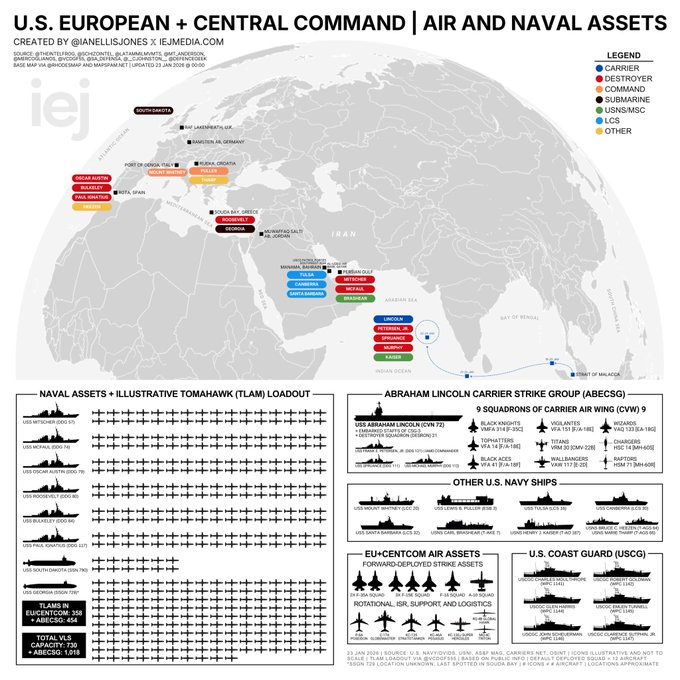
Chart showing massive surge of US air and naval assets to the Middle East in preparation for potential massive US military strikes on the US in the extremely dubious hope of achieving regime change.
This pretext for war is entirely unrelated to US national security and is inconsistent with how the Trump administration has dealt with other, far more murderous regimes. Notably, the Communist regime in Beijing has mass murdered tens of millions of Americans and the US has not waged war against it for the past 73 years. Other regimes like North Korea have killed millions of their own people with no threats of US military retaliation. As I have warned, a protracted war with the likely nuclear armed Iranian regime could quickly become a regional war and potentially a world war leading to the destruction of the US. Homeland from Iranian cyber and super EMP weapons, leading to the deaths of tens of millions of Americans if not many more.
President Trump reportedly called off planned massive US air and missile strikes on Iran on January 14th because the US military could not guarantee the strikes would be successful in achieving his objectives of regime change as well as in response to pressure from US Gulf allies to dissuade him from doing so saying that US strikes on Iran would lead to a protracted regional war similar to the wars in Iraq and Afghanistan that would be difficult to end. Even Israeli Prime Minister Bibi Netanyahu reportedly urged Trump to delay the strikes as Trump’s decision to green light the strikes came as a surprise to him. According to an article in the Times of Israel, Israeli leaders are reportedly divided over US military action against Iran given the regime’s success in crushing Iran’s protesters, a million of whom have been demonstrating for the overthrow of the Islamist regime in the belief that the window for achieving Iranian regime change throw military action has likely passed. In fact, I can think of no instance in history where bombing strikes were successful in achieving regime change without US troops on the ground or a largescale armed opposition movement neither of which are present in Iran right now. At least, Trump was smart enough to realize the likely blowback from the strikes potentially including massive Iranian cyberattacks on the US homeland could be severe.
The CIA and the Mossad appear to have encouraged the badly divided Iranian opposition to rise up with promises of US and Israeli military support. However, that has not materialized, enabling thousands of thousands of opposition members to be massacred by the Iranian regime inviting comparison to the Warsaw Uprising of 1944. Trump is continuing to entertain the risk of provoking the outbreak of World War Three and the potential destruction of the US homeland as he continues to mass US military power for potential US bombing strikes on Iran in response to the failure of the CIA’s failed color revolution in Iran which was encouraged by the US and Israel with pledges of US military support which did not end up happening.
A protracted US war with Iran would likely lead Iran to shut down the Strait of Hormuz through which much of the world’s oil passes causing oil prices to increase by fifty percent making the cost of living go way up. The GOP Congress would pay a heavy price in November, likely with the loss of both Houses of Congress, for Trump’s abrogation of his “no new wars” pledge which has been far more impactful than George HW Bush’s “no new taxes” foul up. Then the Democrats will impeach President Trump a third time next year. Israel proved incapable of intercepting Iranian hypersonic missiles any one of which could end up being nuclear-tipped. Trump would be wise to consider the consequences of unprovoked US military action against Iran not only in terms of the loss of thousands, if not millions, of US and Israeli lives but also to his own presidential legacy particularly given the fact that regime change cannot be achieved by US bombing strikes alone. If Trump stages massive bombing strikes on Iran, the war will spread throughout much of the Middle East and he will be remembered as a failed president mere months after he boasted he had achieved a lasting peace in the region.
While neocons are boosting a massive US attack on Iran as a way to reset the strategic chessboard of the Middle East, the blowback from such an attack could lead to a Sino-Russian alliance reset of the global order in the event the Ayatollah Khamenei responded to a US attempt to assassinate him by ordering a massive cyberattack to destroy all US critical infrastructure, leading the US to cease to exist as a country.
First, the neocons claimed Russia was collapsing after they gave up capturing Kyiv in April 2022. Then, following an economic downturn and the arrest of senior Chinese political and military officials, they claimed the Communist regime in China was on the brink of collapse. When that didn’t happen, they claimed Venezuela’s Communist regime was on the verge of collapse after Trump ordered the kidnapping of Maduro. Now, they are claiming the Islamist regime in Iran is collapsing. It looks like they will be proven entirely wrong on all four counts. There are only two examples of unarmed protesters overthrowing autocratic regimes--the Philippines in 1986 and Taiwan in 2011. There is very little chance that the mass protests will overthrow the Iranian regime. But the bigger question is whether US leaders really want to risk the nuclear-armed regime in Iran collapsing when they could fire off some nukes at Israel, detonate their super EMP satellites over the US or more likely execute a massive cyber and counterspace attack on the US destroying much if not all US critical infrastructure in response to US military intervention? As much as I support the brave Iranians protesting the oppressive Islamic regime, I would argue that the US and Israel would be much safer with the regime remaining in power than that happening.
Conclusion
Great power alliances transformed two regional wars in Eastern Europe into unnecessary world wars that cost us 110 million people and now US membership in NATO threatens to transform the war in Ukraine into an unnecessary Third World War that could cost us the lives of several hundred million more. Over the past four years, we have been seeing several historical parallels between the war in Ukraine and the conditions preceding the outbreaks of both world wars, which are anything but reassuring.
What the vast majority of US leaders fail to understand is that America’s military alliance commitments have the potential to make the US much less safe, not more secure. If America’s so-called NATO ‘allies’ were to stumble into a direct war with Russia, the Kremlin would likely respond by using its massive arsenal of strategic nuclear, theater nuclear, super-Electro-Magnetic Pulse (EMP) weapons, cyber weapons, and counterspace weapons to swiftly destroy NATO’s critical infrastructure and effectively destroy European NATO. However, there would be no assurance that such a NATO-Russia war would be confined to Europe, and it could quickly spread to include the destruction of the US homeland as well.
Accordingly, the Trump administration should implement its new outstanding realist national security strategy to transform the US from a global empire that behaves increasingly like a rogue state bombing multiple nations with impunity, and starting new wars with abandon, back to a peace loving constitutional republic and unchallengeable hemispheric superpower like we were before the outbreak of the Second World War. President Trump can secure his presidential legacy and make the US more safe and secure than ever before by acting immediately to implement a Reaganite policy of peace through strength by negotiating a bilateral agreement ending our war with Russia in Ukraine, exiting NATO’s military command structure, and withdrawing US military forces from the US and the Middle East. Then, we can form a strategic partnership with Russia and India which serves to neutralize their military alliance with the PRC, thereby severely weakening it and altogether eliminating the massive Russian nuclear threat to the US allowing us to focus on deterring Chinese aggression against our great nation.
© David T. Pyne 2026
David T. Pyne, Esq. is a former U.S. Army combat arms and Headquarters staff officer, who was in charge of armaments cooperation with the former Soviet Union, Eastern Europe, the Middle East, Africa and the Americas from 2000-2003, with an M.A. in National Security Studies from Georgetown University. He is the former President and current Deputy Executive Director of the Task Force on National and Homeland Security. He recently served as Defense and Foreign Policy Advisor to former Republican presidential candidate Vivek Ramaswamy. He has also co-authored the best-selling new book, “Catastrophe Now--America’s Last Chance to Avoid an EMP Disaster” and his new book “Restoring Strategic Deterrence” will be published in January 2026. He serves as the Editor of “The Real War” newsletter at dpyne.substack.com and previously served as a contributor to “The National Interest”. Here is a link to his interview archive. He also posts multiple times a day on X at @AmericaFirstCon. He may be reached at emptaskforce.ut@gmail.com.
Recent Interviews
December 23rd—Interview with Brannon Howse on Brannon Howse Live to discuss President Trump’s announcement that the US will build 10-25 new 30,000-40,000 Trump-class battleships, US seizures of Venezuelan oil tankers and Trump’s outstanding new National Security Strategy.
January 2nd—Interview with Nazar Kotovych on his podcast to to discuss discuss Trump’s peace proposal and the prospects for ending the war in Ukraine with a diplomatic peace agreement before Ukraine runs out of troops and collapses militarily in the spring or summer of 2026.
January 4th—Interview with Flora Swain from the Indian Express to discuss President Trump’s attack on Venezuela and removal of Venezuelan President Nikolas Maduro from power and what Trump hoped to accomplish given Venezuela’s Communist regime remains firmly in control of the country.
January 5th—Interview with former US Army officer Stanislav Krapivnik on his Eyes of Truth podcast to discuss Trump’s peace proposal and the prospects for ending the war in Ukraine with a diplomatic peace agreement before Ukraine runs out of troops and collapses militarily in the spring or summer of 2026.
January 5th—Interview with Brannon Howse on Brannon Howse Live to discuss Ukraine’s attack on Putin’s residence in Novgorod, its attack Russia’s underground nuclear command center and whether it’s wise for Trump to commit to a 15-year security guarantee of Ukraine as part of his deeply flawed 20-point peace plan. We will also discuss China’s latest Joint Air-Naval Blockade exercise and Trump’s decision to expose a covert CIA attack on a Venezuelan port.
January 7th—Interview with Brannon Howse on Brannon Howse Live to discuss Trump’s lies about Maduro being a cartel drug lord to justify his attack on Venezuela and the US seizure of a Russian tanker in the North Atlantic and why Trump is right to want to take over Greenland.
January 9th—Interview with Brandon Weichert on his National Security Talk podcast to discuss the latest with regards to the war in Ukraine, China’s joint air naval blockade exercises surrounding Taiwan and Trump’s attack on Venezuela and removal of Venezuelan President Nikolas Maduro from power.
January 15th—Interview with Brannon Howse on Brannon Howse Live to discuss Trump’s purported plan to bomb Iran in an attempt to overthrow its Islamic regime in support of the opposition members protesting against the regime. We will also talk about Trump’s threat to annex Greenland one way or the other—the hard way or the easy way.
January 20th—Interview on Main Street Radio with Jon Twitchell on his Talk with Jon show to discuss the latest news regarding the war in Ukraine, China’s plans to blockade and/or invade Taiwan and Trump’s plan to overthrow the Maduro regime in Venezuela.
Upcoming Interviews
January 26th—Interview with Brandon Weichert on his National Security Talk podcast to discuss the latest with regards to the war in Ukraine, Trump’s attempt to gain control of Greenland and his seeming march to war with a nuclear-armed Iran.
January 26th—Interview with COL Rob Maness on the Rob Maness Show to discuss Trump’s Board of Peace and his failed attempt to annex Greenland as well as Trump’s continued threats to bomb Iran and start World War Three.
I think I see what the plan is. Foment insurrection in Iran with two main objectives (following upon the regime change). Acquire control over Iran's oil. In the process of attacking Iran kinetically, provide a plausible cover story for an internet problem in the US (another emergency). It will be a false flag, and be blamed on Iran (easy to do, since they've threatened retaliation for any attack on themselves). The problem reaction solution to the internet emergency will be Digital ID. There will be no escape from that for the rest of us. Instant totalitarianism, and anybody who doesn't like it will be made homeless and destitute.